
A Guide To Product Data Management And Branding Across Marketplaces
A practical guide to Product Data Management for growing brands: what it is, why it matters, how to manage it across marketplaces, and how it protects brand consistency at scale.


A business that sells on one channel can usually keep its product information straight with a spreadsheet and a bit of discipline. That stops working the moment a second sales channel enters the picture, and it breaks down completely by the third or fourth. A product description written for a company’s own website doesn’t fit a marketplace’s character limit.
An image that looks fine on a product page gets rejected for having the wrong background. A price update made in one system takes three days to show up somewhere else, and in the meantime a customer buys something that’s actually out of stock.
This is the point where most growing brands realize they don’t have a marketplace problem. They have a product data problem. Product Data Management is the discipline that addresses it: a structured way to collect, organize, standardize, and distribute product information so that it stays accurate and consistent no matter how many places a customer might encounter it.
Done well, it’s invisible. Done poorly, it shows up everywhere, in mismatched listings, in customer complaints, and eventually in a brand that looks less trustworthy than it actually is.
What Is Product Data Management?
Product Data Management refers to the processes and systems a company uses to create, store, maintain, and distribute the information that describes its products. That includes the obvious things, like titles, descriptions, and prices, but also the less visible details: technical specifications, product identifiers, category assignments, compliance documentation, and the relationships between a base product and its variants.
The distinction between Product Data Management and simply “keeping track of products” comes down to structure. A spreadsheet with product names and prices is a record. Product Data Management is a system, meaning there’s a defined process for how new products get added, how existing data gets updated, who is allowed to make changes, and how that information flows out to every place it needs to appear.
When a company has real product data management in place, updating a price or fixing a typo in a description happens once, in one place, and the correction propagates everywhere automatically instead of requiring someone to log into five different systems.
This matters more as a catalog grows. A company with fifty products can survive on manual effort and good intentions. A company with five thousand SKUs across a dozen sales channels cannot. At that scale, product data management stops being a nice-to-do and becomes the thing that determines whether the business can operate at all.
Why Product Data Management Matters for Modern Ecommerce
The case for investing in product data management is practical, not theoretical. A few concrete outcomes make the difference clear.
- Accuracy. When product information lives in one authoritative place, there’s no ambiguity about which version is correct. Nobody has to guess whether the price in the ERP system or the price on the marketplace listing is the current one.
- Consistency. A customer who sees a product on a company’s website and then again on a third-party marketplace should recognize it as the same product, described in a recognizably similar way. Wildly different descriptions, specifications, or even product names across channels undermine that recognition.
- Speed. New product launches and seasonal updates move faster when there’s a single workflow for pushing changes out, rather than a separate manual process for each channel.
- Fewer listing errors. Marketplaces reject or suppress listings that are missing required attributes or formatted incorrectly. Centralized data with built-in validation catches these problems before they become disapprovals.
- Better marketplace compliance. Every marketplace has its own rules for what counts as an acceptable listing, and those rules change over time. A managed data process makes it realistic to keep up with those changes instead of discovering them after a product gets flagged.
- Stronger internal workflows. Teams stop wasting time hunting for the “real” version of a product description or chasing down who last updated a spec sheet, because there’s one place to look.
Consider a mid-sized housewares brand adding a fourth marketplace to its existing three. Without a managed process, that means a fourth set of manual uploads, a fourth place where prices can drift out of sync, and a fourth opportunity for someone to copy over an outdated product description by mistake.
With product data management in place, the new marketplace is mostly a configuration exercise: map the existing catalog to the new channel’s requirements, and the rest of the process, keeping data fresh and consistent, already exists.
What Types of Product Data Need to Be Managed?
Product data isn’t a single field or a single file. It’s a collection of different data types that serve different purposes, and a mature Product Data Management approach accounts for all of them.
- Product names and titles
- Descriptions, both short and long-form
- Technical specifications
- Product attributes (color, size, material, and category-specific fields)
- SKU numbers and other product identifiers, including UPC, EAN, and GTIN
- Pricing, including any promotional or channel-specific pricing
- Dimensions and weight, both packaged and unpackaged where relevant
- Product images
- Videos and other rich media
- Technical documents, such as spec sheets or installation guides
- Certifications and compliance documentation
- Category and taxonomy assignments
- Product variants and how they relate to a parent product
- Shipping information
- Warranty terms
- Brand information, including logos and approved brand language
Not every product needs every field. A t-shirt doesn’t need a wattage rating, and a kitchen appliance doesn’t need a size chart. This is one of the more underappreciated parts of product data management: building a data model flexible enough to apply different required fields to different product categories, rather than forcing every product through the same rigid template.
A company selling electronics and apparel through the same catalog needs a system that treats those as genuinely different data structures, not a single one-size-fits-all spreadsheet.
Product Data Management vs Product Information Management
These two terms get used almost interchangeably in casual conversation, and vendors don’t always help matters by using them inconsistently in their own marketing. But there’s a real, if sometimes blurry, distinction worth understanding.
In its more traditional, engineering-oriented definition, Product Data Management (PDM) refers to managing technical data through the design and manufacturing process: CAD files, engineering specifications, bills of materials, and version control during product development. It’s used primarily by engineering and manufacturing teams, and it’s closely related to Product Lifecycle Management (PLM) software.
Product Information Management (PIM), by contrast, is generally used to describe the systems that centralize and enrich customer-facing product content, the descriptions, images, attributes, and marketing copy that make a product ready to sell across ecommerce sites, marketplaces, and other customer touchpoints. PIM is the discipline most directly tied to the ecommerce and marketplace challenges this guide focuses on.
In practice, when people in ecommerce and marketplace operations say “product data management,” they’re often talking about what would more precisely be called PIM: managing the customer-facing catalog rather than internal engineering data. That’s not wrong, exactly, it’s just worth knowing that the term carries two related but distinct meanings depending on who’s using it and in what context.
A manufacturing company might use PDM software for its engineering teams and a separate PIM or catalog management system for its customer-facing listings, with the two systems feeding into each other. Smaller ecommerce and DTC brands, meanwhile, tend to use “product data management” loosely to describe the whole process of maintaining accurate, sellable product content, regardless of which formal software category that falls under.
The Challenges of Managing Product Data Across Multiple Channels
Most of the pain in this space isn’t caused by any single mistake. It’s caused by the same small inefficiencies compounding across every product and every channel. The common patterns include:
- Duplicate product information scattered across spreadsheets, the company’s own site, and each marketplace’s backend
- Missing attributes that a marketplace requires but that never made it into the original product record
- Incorrect specifications, often the result of copying and pasting from an old version of a product
- Outdated descriptions that reference a discontinued feature or an old packaging design
- Inconsistent product naming, where the same item is called something slightly different on each channel
- Marketplace-specific requirements that conflict with each other, forcing manual reformatting for every channel
- Heavy reliance on spreadsheets as the source of truth, with no real version control
- Manual data entry, which introduces errors at a rate that scales with catalog size
- Duplicate SKUs created when the same product gets listed more than once by mistake
- Poor image management, including outdated photos or images that don’t meet a channel’s technical requirements
- Inconsistent brand messaging across channels, where tone and terminology drift over time
- Marketplace feed errors that cause products to be rejected or suppressed without an obvious explanation
- Difficulty tracking who changed what and when, especially when multiple people can edit the same product record
The business impact of these problems rarely shows up as one dramatic failure. It shows up as a slow accumulation of small ones: a listing that quietly stops appearing in search results because an attribute went missing, a customer who orders a product that’s actually out of stock because inventory data lagged behind, a support ticket generated by a description that doesn’t match what actually arrived. None of these individually looks like a crisis. Together, they represent real lost revenue and a steady erosion of customer trust.
Managing Product Data Across Ecommerce Marketplaces
Every major marketplace has its own expectations for what a complete, compliant product listing looks like, and those expectations genuinely differ from one platform to the next, not just in cosmetic ways.
Google Merchant Center, for instance, publishes a formal product data specification that defines required and optional attributes for products to appear in Shopping ads and free listings. At minimum, products need core fields like an ID, title, description, link, image, price, and availability, along with a valid product identifier such as a GTIN where one has been assigned by the manufacturer.
Google updates this specification periodically, adding new attributes and adjusting requirements, which means a static, one-time export of product data tends to fall out of compliance over time without anyone noticing until listings start getting disapproved.
Amazon and Walmart illustrate just how different two major marketplaces can be from each other. Amazon generally allows for a more flexible, self-service onboarding process, with GTIN exemptions available in some categories and a search algorithm that has historically rewarded longer, keyword-dense titles.
Walmart Marketplace takes a stricter approach: it requires a valid GTIN for essentially every listing, reviews new seller applications manually, and places heavier weight on complete, accurate product attributes as a ranking factor, while generally preferring shorter, more literal product titles than Amazon does.
A product feed built entirely around Amazon’s conventions won’t automatically perform well on Walmart, and in some cases won’t even be accepted, without deliberate reformatting.
Other channels add their own layers of complexity on top of that. eBay and Target Plus each have their own category structures and listing standards. Shopify and WooCommerce, since they power a brand’s own storefront rather than acting as a shared marketplace, offer far more flexibility but require the brand itself to maintain data quality without the constant automated checks a marketplace applies.
Industry-specific marketplaces, whether in B2B, industrial supply, or specialty retail, often layer additional compliance or documentation requirements on top of the basics.
None of this means every marketplace requires an entirely separate catalog built from scratch. The practical approach is to maintain one centralized, authoritative version of each product, sometimes called a golden record, and then apply channel-specific mapping and transformation rules on top of it. The core product information (what the product is, what it does, its accurate specifications) stays the same.
What changes is how that information gets formatted, which fields get included, and which optional attributes get added to meet each channel’s specific requirements. This is fundamentally different from maintaining five separate, independently edited versions of the same product, because a correction made to the source data flows through to every channel automatically rather than requiring five manual updates.
How Product Data Management Supports Brand Consistency
Product data and brand identity are more closely connected than most companies initially assume. A brand isn’t just a logo or a tagline. It’s the cumulative impression a customer forms from every touchpoint, and product listings are one of the touchpoints customers encounter most often.
When a company’s product naming conventions shift from channel to channel, when the tone of a description on the company website reads nothing like the tone on a marketplace listing, or when product images vary wildly in quality and style, customers notice, even if only subconsciously. A product that looks premium on one channel and looks like an afterthought on another creates doubt about which version is the “real” brand experience. That doubt is corrosive to trust, and trust is what actually drives repeat purchases.
Consistent product data supports brand consistency across several dimensions: product naming that follows the same conventions everywhere, a recognizable tone of voice in descriptions, approved imagery and logo usage, consistent product claims that don’t overstate or understate what a product actually does, standardized specifications, agreed-upon brand terminology, coherent category structures, and consistent product positioning relative to competitors.
None of this happens by accident once a brand is selling across five or ten channels. It happens because someone has defined the standards and built a process that enforces them by default rather than relying on every team member to remember the house style every time they touch a listing.
This is also where product data management and brand strategy genuinely intersect, and where companies sometimes underinvest relative to how much it matters. Fast-growing SaaS companies, for example, often treat their public-facing product pages as an extension of brand identity from day one, which is part of why specialized SaaS branding work tends to focus heavily on consistent product language and positioning across every surface a prospective customer might see.
Building a Centralized Product Data Management Workflow
A workable product data management process tends to follow a similar sequence regardless of company size or industry. The details vary, but the shape of the workflow doesn’t change much.
- Collect product data. Gather information from every existing source: supplier spec sheets, internal product teams, photography, existing marketplace listings, and legacy spreadsheets.
- Centralize information. Bring everything into one system that serves as the single source of truth, rather than leaving data spread across departments and file formats.
- Standardize attributes. Define consistent field names, units of measurement, and formatting rules so that “color” doesn’t show up as three different field names across three different product categories.
- Clean and validate data. Identify and fix missing fields, duplicate entries, and obvious errors before that data gets published anywhere.
- Enrich product content. Add the descriptive, marketing-oriented content, expanded descriptions, lifestyle imagery, comparison charts, that turns a bare technical record into something that actually sells.
- Organize product taxonomy. Assign products to a logical category structure that makes sense both internally and for how customers search and browse.
- Apply brand guidelines. Run product content through a consistent style, tone, and visual standard before it goes live anywhere.
- Map data to marketplace requirements. Translate the centralized product record into the specific format, fields, and attributes each channel requires.
- Publish or syndicate product data. Push the finished, channel-specific listings out to each marketplace, storefront, or feed.
- Monitor and update listings. Track listing health over time, catch errors or compliance issues early, and route any product changes back through the same process rather than editing live listings directly.
The workflow only holds up if updates always start at the centralized source rather than being made directly on an individual marketplace listing. The moment someone edits a listing directly on Amazon without updating the source record, that channel’s data starts to drift from everywhere else, and the whole point of centralization quietly breaks down.
How to Improve Product Data Quality
Data quality is often discussed in the abstract, but it breaks down into specific, checkable principles.
- Accuracy means the data reflects the actual product: correct dimensions, correct materials, correct functionality.
- Completeness means every required and reasonably useful field has been filled in, rather than left blank or filled with a placeholder.
- Consistency means the same product is described the same way, using the same terminology, everywhere it appears.
- Timeliness means the data reflects current reality, not a version of the product from six months ago.
- Validity means data conforms to the expected format, a price field contains a number, a date field contains a date, rather than free text that breaks downstream systems.
- Uniqueness means each product exists as a single record rather than several duplicate entries competing with each other.
- Traceability means there’s a record of who changed what and when, which matters both for accountability and for troubleshooting when something goes wrong.
A concrete comparison helps illustrate the difference. A low-quality product record might read: “Great chair, comfortable, many colors.” A high-quality record for the same product would specify the exact material, dimensions, weight capacity, the specific color options available with accurate names, and a description that reflects what a customer would actually want to know before buying.
The second version isn’t just more polished. It’s the version that actually satisfies marketplace requirements, ranks better in search, and reduces the odds of a return caused by mismatched expectations.
Product Data Governance: Who Owns Product Information?
One of the most common reasons product data management efforts fail isn’t a lack of software. It’s a lack of clarity about who’s actually responsible for keeping the data accurate. When ownership is unclear, everyone assumes someone else is handling it, and small errors go uncorrected for months.
Different roles typically touch product data for different reasons. Product teams define the core specifications. Ecommerce teams manage how products appear across digital storefronts. Marketing and brand teams shape tone, positioning, and visual standards. Sales teams often surface real-world feedback about what information customers actually ask for.
Operations and inventory teams keep stock and fulfillment data current. IT typically owns the systems and integrations that make all of this flow correctly. Marketplace managers handle the channel-specific requirements and troubleshoot listing issues as they arise.
Good governance doesn’t mean one person owns everything. It means there’s a documented process for who can edit what, who approves changes before they go live, and how conflicting edits get resolved when two teams touch the same product record at the same time. Without that structure, it’s common to see one team update a description while another team, unaware of the change, overwrites it a week later with an older version.
This kind of quiet conflict is especially common in industries where accuracy carries regulatory weight. A financial services company rolling out a new product tier, for example, needs product descriptions that are both compliant and on-brand, which is exactly the kind of cross-functional coordination that specialized fintech branding work is often brought in to help structure.
Product Data Management for Product Variants and Large Catalogs
Complexity multiplies fast once a catalog includes variants. A single t-shirt design that comes in five colors and six sizes isn’t one product, it’s potentially thirty individual SKUs, each of which needs its own inventory tracking, its own identifier, and often its own marketplace listing, while still needing to be presented to the customer as a single, coherent product.
This is where the concept of parent-child relationships becomes useful. A “parent” product record holds the information shared across all variants, the base description, the brand, the general specifications, while “child” records hold the information specific to each variant, like size, color, or a particular configuration. Structuring data this way means a single update to the parent description flows down to every variant automatically, rather than requiring the same edit to be made thirty separate times.
The complexity compounds further with bundles, regional versions of the same product, and different packaging configurations for different retail channels. A company that manufactures a product sold both to consumers directly and to industrial distributors, for example, might need entirely different specification sheets, different compliance documentation, and different packaging data for the same underlying item.
This kind of structural complexity is common enough in industrial and manufacturing contexts that it often extends into how a company presents itself more broadly, which is part of why manufacturing branding work frequently has to account for multiple audiences, distributors, retailers, and end consumers, receiving fundamentally different versions of the same product story.
Automation and Product Data Management
Automation earns its keep in product data management primarily on repetitive, well-defined tasks. Validating that required fields are filled in, checking that a price falls within an expected range, flagging likely duplicate SKUs, mapping standard attributes to a marketplace’s required format, and generating a properly formatted feed file are all tasks that automation handles reliably, because the rules governing them are clear and consistent.
Other tasks still benefit from human judgment, at least for now. Writing a genuinely persuasive product description that captures what makes a product distinctive, resolving ambiguous or conflicting data from two different suppliers, and deciding how a new product should be categorized when it doesn’t fit neatly into an existing taxonomy are all areas where automated tools can assist but shouldn’t be trusted to make the final call unsupervised.
The practical approach most mature teams settle on is having automation handle the mechanical, rule-based work while routing anything that requires judgment, nuance, or brand voice to a person for review before it publishes.
How AI Is Changing Product Data Management
AI tools have found genuinely useful, narrow applications within product data management over the past few years. They can generate a first draft of a product description from a spec sheet, which a human then edits rather than writes from scratch. They can extract structured attributes from unstructured product documents, pulling dimensions or materials out of a PDF spec sheet automatically.
They can suggest likely category assignments for new products, flag descriptions that look inconsistent with similar products in the catalog, translate product content into other languages, propose title variations tailored to a specific marketplace’s conventions, and adapt content for different channel requirements faster than a person doing the same work manually.
These are real, useful capabilities, and treating them as such, rather than as a replacement for human oversight, is where companies get the most value. AI-generated descriptions can include specifications that sound plausible but aren’t actually accurate for the specific product being described. They can flatten distinct products into similar-sounding, generic copy that erodes the brand voice a company worked to establish.
They can be inconsistent in terminology from one product to the next in ways a human editor would catch immediately. None of this means AI shouldn’t be used. It means the output needs review before it goes live, particularly for anything involving a factual claim, a technical specification, or a regulated product category where an inaccurate description carries real consequences.
Choosing a Product Data Management System
Selecting a system is less about finding the vendor with the longest feature list and more about matching a platform’s actual capabilities to a company’s specific catalog and channel complexity. A few factors deserve close attention during evaluation.
| Factor | What to Evaluate |
|---|---|
| Catalog size | Whether the system performs well at your current SKU count and has room to grow |
| Sales channels | Native support or integrations for the specific marketplaces and storefronts you use |
| Data model flexibility | Ability to define different attribute sets for different product categories |
| Attribute and taxonomy management | Tools for organizing categories and standardizing fields across the catalog |
| Workflow and approvals | Configurable review processes before content goes live |
| User permissions | Role-based access so the right teams can edit the right data |
| Validation rules | Automated checks for missing or incorrectly formatted data |
| Marketplace integrations and API support | Direct connections to the channels you sell on, plus flexibility for custom integrations |
| Automation capabilities | Support for rule-based tasks like mapping, enrichment, and feed generation |
| Reporting and version control | Visibility into listing health and a history of changes over time |
| Scalability | Whether the system’s performance and pricing hold up as the catalog and channel count grow |
| Security | Appropriate access controls and data protection standards |
| Total cost of ownership | Licensing, implementation, and ongoing maintenance costs, not just the sticker price |
No single system is the right answer for every company. A brand selling a few hundred SKUs on two channels has very different needs than one selling tens of thousands of SKUs across fifteen channels, and the right evaluation process weighs current needs honestly against realistic growth rather than buying for a scale the company may never reach.
Common Product Data Management Mistakes
Certain mistakes show up again and again across companies of very different sizes and industries.
- Treating a spreadsheet as a permanent source of truth instead of a temporary starting point
- Copying the exact same product description across every channel without adapting it to each one’s format and audience
- Ignoring marketplace-specific requirements until a listing gets rejected
- Allowing uncontrolled edits from multiple teams with no approval process
- Failing to standardize attributes early, which makes cleanup exponentially harder later
- Using inconsistent product naming across departments and channels
- Treating product images as an afterthought rather than a core part of the data
- Never auditing existing data, so errors accumulate silently for years
- Automating processes on top of data that’s already low quality, which just scales the errors faster
- Never assigning clear ownership over who’s responsible for product data accuracy
Most of these mistakes are avoidable, and none of them require sophisticated technology to fix. They require deciding, early, that product data is worth treating as a real asset rather than administrative overhead.
A Practical Product Data Management Checklist
- Is there a single, centralized source of truth for product data, or is it scattered across multiple systems?
- Are attribute names and formats standardized across the entire catalog?
- Is there a documented process for how new products get added and existing ones get updated?
- Are marketplace-specific requirements mapped and kept current as each channel updates its rules?
- Is there validation in place to catch missing or incorrectly formatted data before it publishes?
- Is product imagery consistent in quality and meets each channel’s technical requirements?
- Is there clear ownership over who can edit product data and who approves changes?
- Is there a process for keeping pricing and inventory synchronized across channels in near real time?
- Are brand tone, terminology, and visual standards applied consistently across every channel?
- Is listing health monitored on an ongoing basis, rather than only checked when sales drop?
A brand that can answer “yes” to most of these already has the foundation of real product data management in place. A brand answering “no” to most of them isn’t necessarily in trouble, but it’s a strong signal that the current process won’t hold up as the catalog or channel count grows.
The Future of Product Data Management
A few realistic trends are already shaping where this discipline is headed. Automation will keep expanding into more of the mechanical, rule-based work: validation, mapping, and feed generation, freeing up human attention for the parts of the process that genuinely require judgment.
AI-assisted enrichment will get better at handling first-draft content and attribute extraction, though human review is likely to remain necessary for accuracy and brand voice for the foreseeable future, rather than disappearing entirely.
Real-time data synchronization between systems will become more standard, reducing the lag between a change made in one place and that change reflecting everywhere else. Product data itself will likely become more structured over time, as marketplaces continue adding more granular attribute requirements to support better search and filtering.
And as omnichannel commerce continues to blur the line between browsing, comparing, and buying, marketplace integrations will need to get tighter, not looser, to keep listings accurate across a growing number of touchpoints.
None of this points toward product data management becoming less important. If anything, as the number of channels a typical brand sells through keeps growing, the cost of getting product data wrong grows right along with it.
Companies that treat this as core infrastructure now, rather than reacting to problems after they surface, will have a real head start over the ones that keep patching things together channel by channel, as they’ve been doing all along.
Ecommerce-focused brands in particular tend to feel this pressure earliest, which is part of why ecommerce branding strategy and product data strategy increasingly need to be built together rather than treated as separate workstreams handled by separate teams that rarely talk to each other.
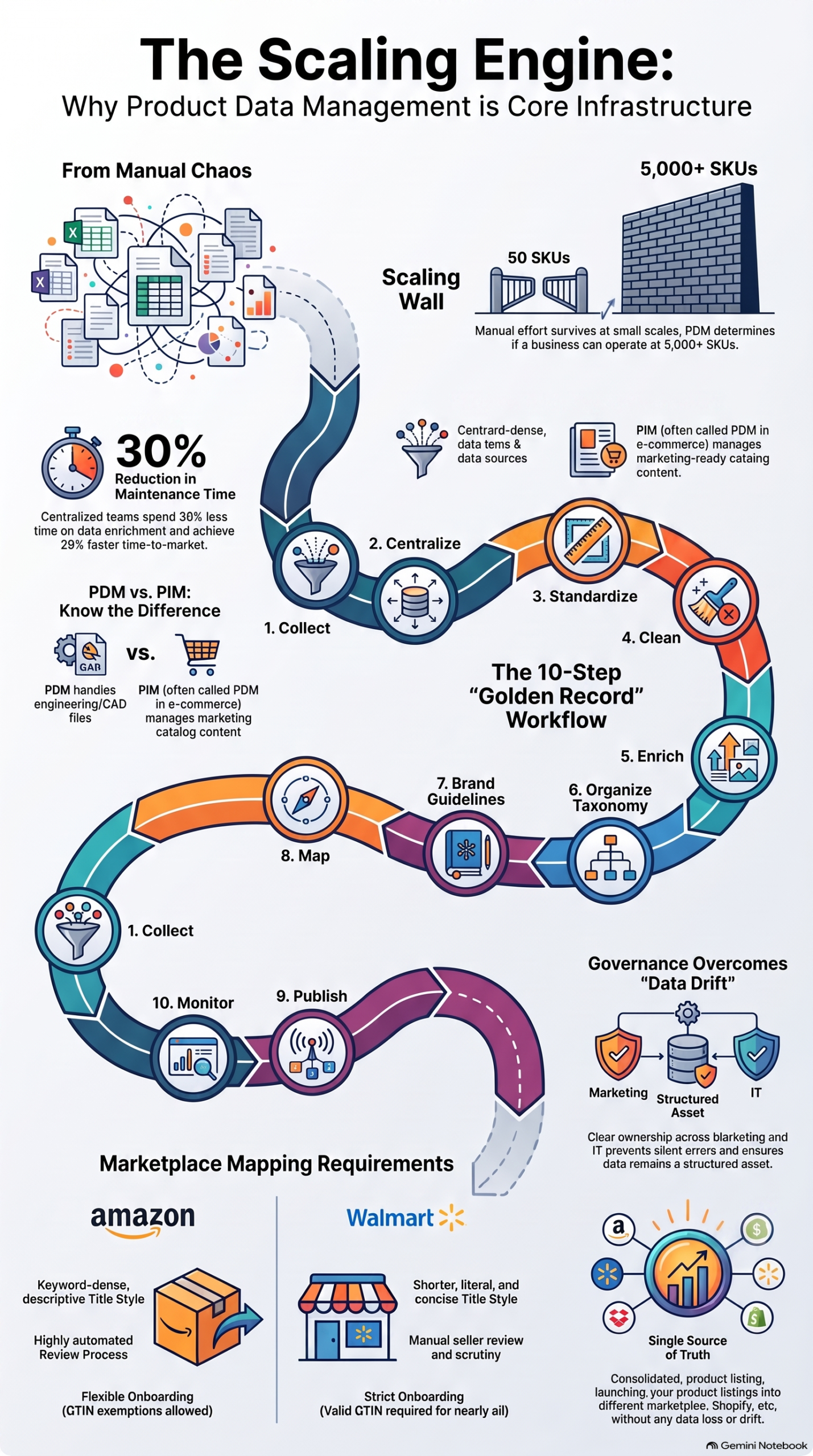
Product Data Management: The Scaling Engine for Modern Product Operations
Product Data Management becomes increasingly important as businesses expand their product catalogues across multiple channels and marketplaces. The infographic below illustrates how a structured PDM workflow helps businesses move from fragmented product data to a centralised, governed “golden record,” while supporting SKU scalability, data quality, brand consistency and marketplace-specific requirements.
Conclusion
Product Data Management isn’t a single tool or a single fix. It’s the ongoing discipline of keeping product information accurate, complete, and consistent everywhere a customer might encounter it, from a company’s own website to a dozen different marketplaces with a dozen different sets of rules.
Done well, it reduces errors, speeds up expansion into new channels, and reinforces a brand’s credibility every time a customer sees a listing that looks accurate and trustworthy. Done poorly, or not at all, it becomes an invisible tax on growth, one that shows up as lost sales, rejected listings, and a brand that looks less coherent than the company behind it actually is.
As catalogs grow and channels multiply, the businesses that treat product data as a structured, owned, and continuously maintained asset are the ones that scale without their product information, or their brand, falling apart along the way.
Published by BrandingX.


