

Underwear used to be the most anonymous thing in a closet. It came folded in a plastic three-pack, it was chosen by size and price, and almost nobody could name the company that made it. That arrangement has quietly fallen apart. Shoppers now read fabric content on underwear the way they read ingredient labels on food, they compare waistband widths in online reviews, and many of them can identify a brand from two inches of elastic.
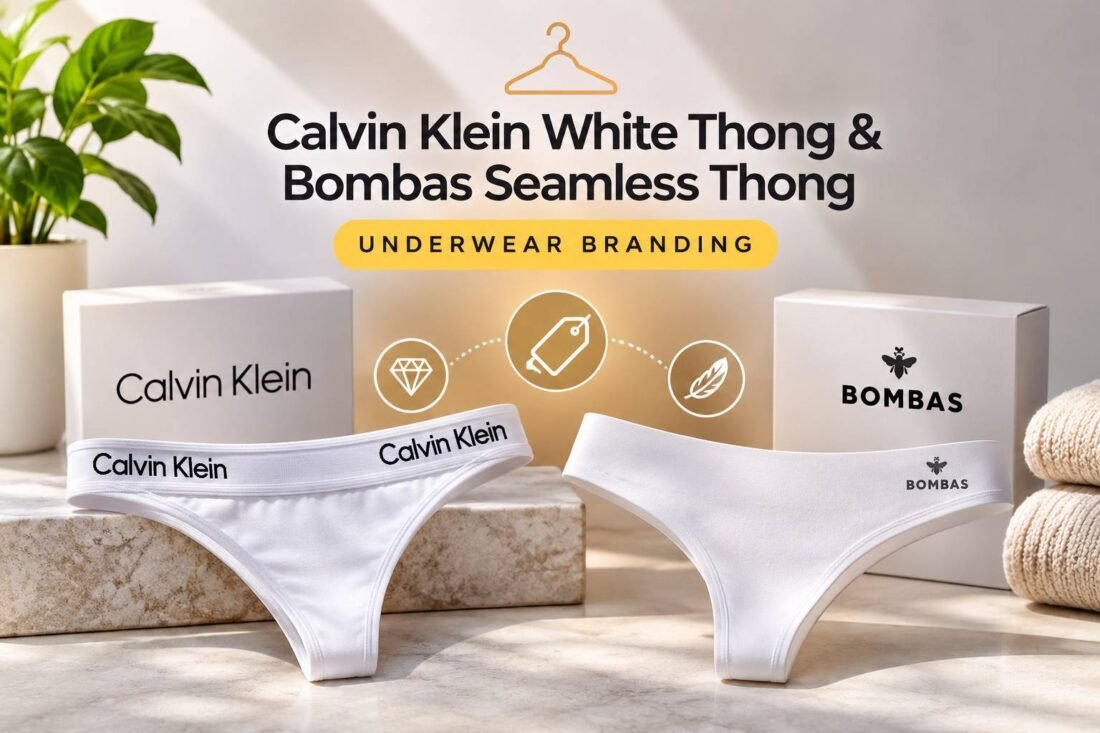
Two very different products show how far the category has moved. A Calvin Klein White Thong carries one of the most recognized waistbands in fashion, and its appeal rests heavily on what that logo signals. A bombas seamless thong, by contrast, makes almost no visual statement at all. Its pitch is about fabric, fit, and how little you notice it during the day. Both sell into the same drawer, often to the same customer, yet they reach her through opposite branding logic. Understanding that contrast is a useful way to understand modern underwear branding as a whole.
This article looks at how each brand turns a small, simple garment into a carrier of identity, what that tells us about consumer purchasing decisions, and what smaller apparel companies can borrow from both approaches.
Calvin Klein White Thong: The Influence of Minimalist Fashion Branding
Calvin Klein built its reputation on restraint. The label, founded in New York in 1968, became known for clean lines, neutral colors, and an absence of decoration that read as confidence rather than plainness. That aesthetic transferred unusually well to underwear, a product category where there is very little to decorate in the first place.
The brand entered the underwear business in 1982, and its first campaign is still cited as a turning point in apparel advertising. According to a Wallpaper* history of the Calvin Klein logo, that debut appeared on a Times Square billboard featuring a Bruce Weber photograph of Olympic pole vaulter Tom Hintnaus. The image did something underwear marketing had rarely attempted. It treated a basic garment as a fashion object worth looking at.
Why the waistband matters more than the garment
The real branding asset was not the cut of the underwear. It was the elastic waistband with the Calvin Klein name repeated across it. Most fashion logos sit on a tag, a buckle, or a small embroidered patch. Calvin Klein put its name on the one part of the product most likely to be seen when it was worn, and in doing so turned the customer into a moving advertisement.
That decision still shapes the women’s line. On Calvin Klein’s own product pages, the Modern Cotton Thong is described as being designed with the original logo waistband and as a sporty look that can be worn under anything. Retailer listings for the same style describe a cotton, modal, and elastane blend, a high leg line, and minimal rear coverage. Composition can vary by collection and market, so shoppers should check the label on the specific item, but the waistband is the constant.
Simplicity as a premium signal
The white version of the thong is a good case study precisely because it is so plain. White cotton underwear is about as basic as apparel gets. What separates a Calvin Klein White Thong from an unbranded one is mostly the logo band and the decades of imagery attached to it. Calvin Klein’s U.S. store lists women’s thongs in core shades including white, black, and nude, along with prints, which keeps the core product consistent while giving the assortment some variety.
This is how minimalist fashion branding tends to work. When a product has few design elements, each one carries more weight. A clean white body with a black logo band reads as deliberate, and that deliberateness is what customers associate with a premium label. The garment does not need lace or hardware to feel considered. It needs to look exactly like itself every time someone buys it.
Bombas Seamless Thong: How Comfort Becomes a Brand Differentiator
Bombas came to underwear from a completely different direction. The New York company was founded in 2013 by Randy Goldberg and David Heath and built its name on socks, along with a giving model it summarizes as “One Purchased = One Donated.” The brand’s core argument was that ordinary essentials deserved more engineering attention than they usually got.
When Bombas expanded into underwear in January 2021, MR Magazine reported that the launch included a seamless style for women in thong, bikini, and hipster silhouettes, offered in straight and plus sizes from XS to 2X. The same report noted tagless construction and reduced seaming, and quoted the founders saying they wanted to apply their comfort-focused approach to other items worn closest to the body. That framing tells you nearly everything about how the brand positions its underwear.
What the bombas seamless thong actually is
On the official Bombas Women’s Seamless Thong product page, the company describes a blend of nylon, modal (which it explains is made from beech tree pulp), and a small amount of spandex, intended to be lightweight and breathable while staying supportive. The page lists the body fabric as a TENCEL Modal, nylon, and elastane blend, notes a ribbed texture, and says the brand removed scratchy tags. It also describes the sizing as inclusive and advises customers who fall between sizes to size down. At the time of writing, the single thong was listed at $18, with three-pack and six-pack options. Exact fabric percentages differ slightly between some single and multipack listings, which is worth noting for anyone writing product copy or comparisons.
The bombas seamless thong does not ask to be seen. Its value proposition is the opposite of a display waistband: it is meant to disappear under clothing and on the body. That is a harder thing to market, because the benefit is an absence of discomfort rather than the presence of a recognizable symbol.
Turning invisible benefits into a brand story
Bombas solves that problem with specificity. Instead of describing the product with mood words, its copy names the fiber, explains where it comes from, lists what was removed, and gives practical sizing advice. Seamless construction itself becomes a feature with a clear consumer meaning: fewer lines under fitted clothes and fewer edges that rub.
The giving model adds an emotional layer that the product alone cannot provide. A shopper buying a comfort-focused underwear basic is also buying into a brand promise that extends beyond the garment. For Bombas, product differentiation and mission work together. The fabric explains why the product feels good, and the donation model explains why the company exists.
Calvin Klein vs. Bombas: Two Different Approaches to Modern Underwear Branding
It would be easy to reduce this comparison to “style versus comfort,” but that misses what each company is actually doing. Calvin Klein sells comfort too, and Bombas cares about appearance. The difference lies in what each brand chooses to make visible.
Calvin Klein externalizes its identity. The brand lives on the outside of the product, in the waistband and in the advertising culture surrounding it. Bombas internalizes its identity. The brand lives in the fabric, the construction, and the reasons the company gives for its choices. One brand is recognized from across a room. The other is recognized after you have worn it for a day.
| Branding dimension | Calvin Klein | Bombas |
|---|---|---|
| Core identity | Minimalist fashion label with deep advertising heritage | Comfort-focused essentials brand with a giving mission |
| Primary recognition cue | Logo waistband with repeated brand name | Product feel, construction details, and brand mission |
| Role of visibility | Designed to be seen; the logo is part of the look | Designed to go unnoticed under clothing |
| Product messaging | Iconic design, signature waistband, everyday style | Named fibers, tagless finish, seamless construction, sizing guidance |
| Advertising heritage | Celebrity and fashion photography, landmark billboards, social campaigns | Direct-to-consumer storytelling built around comfort and giving |
| Typical purchase motivation | Brand affinity, aesthetic identity, recognizable style | Everyday comfort, practical performance, values alignment |
Neither model is inherently stronger. They answer different customer questions. Calvin Klein answers “What does this say about me?” Bombas answers “How will this feel?” Many shoppers ask both questions on different days, which is why the two brands can coexist in the same underwear drawer without competing directly for every purchase.
How Underwear Branding Has Changed Over the Years
For much of the twentieth century, underwear was sold primarily as a functional product. Department stores grouped it by size and fabric, and packaging focused on durability and value. Branding existed, but it was rarely the reason someone chose one pair over another.
The rise of designer underwear
Designer labels changed that by applying fashion values to basics. Calvin Klein’s 1982 launch is the most cited example because it combined three things at once: a recognizable designer name, a visible logo on the garment, and advertising that treated underwear as image rather than utility. Other labels followed with their own branded waistbands, and the logo band became a common design device across the market.
Celebrity campaigns and fashion photography
Through the 1990s, underwear advertising leaned heavily on fashion photography and recognizable faces. Calvin Klein’s campaigns from that era, including well-known images featuring Kate Moss and Mark Wahlberg, helped make the waistband part of popular culture rather than just a product detail. The underwear itself barely changed. Its meaning did.
Social media and user-generated branding
The next shift moved the camera into customers’ hands. In February 2014, Calvin Klein’s parent company PVH announced the “show yours. #mycalvins” campaign, which initially enlisted more than 100 global opinion leaders to post images of themselves wearing the brand. The release said the idea grew out of behavior the company was already seeing from consumers online. It was an early, high-profile example of a fashion brand building a campaign around influencer and user-generated content rather than treating social media as an afterthought.
Comfort, fit, and the direct-to-consumer era
At the same time, ecommerce lowered the barrier for newer brands to sell basics directly. Companies like Bombas could explain fabric choices in detail, collect reviews at scale, and offer packs and sizing guidance without relying on department store shelf space. Comfort moved from an assumed baseline to a marketable feature. Inclusive sizing became a more visible expectation, and product pages began carrying the kind of technical detail once reserved for athletic wear.
Why Product Design Matters in Modern Underwear Branding
In a category with so little surface area, small design decisions do a large share of the branding work. Every choice either reinforces the brand’s story or quietly contradicts it.
- Fabric selection. Bombas names its fibers and explains them, which turns material into a trust signal. Calvin Klein’s Modern Cotton line leads with the familiarity of cotton, which fits a brand built on wardrobe classics.
- Seamless construction. For a comfort-led brand, seamless knitting is the product promise made physical. If the edges dig in, the brand story fails at the moment of use.
- Waistband design. Calvin Klein’s band is its logo. A comfort brand’s band is judged on whether it stays flat and stays put. Same component, different job.
- Fit and silhouette. Consistent fit across colors and seasons builds repeat purchases, because customers learn that their size is reliable.
- Color selection. White, black, and skin-tone neutrals anchor both assortments. Seasonal colors and prints add novelty without disturbing the core line.
- Packaging and presentation. A box, a hanger, or a mailer is often the customer’s first physical contact with the brand. It should look like it came from the same company as the website and the ads.
- Consistency across collections. A Calvin Klein logo waistband looks recognizably similar across underwear, bralettes, and loungewear. Bombas repeats its comfort language across socks, underwear, and T-shirts. Both create a family resemblance that helps customers trust new products.
The common lesson is alignment. A minimalist label cannot ship a fussy product, and a comfort brand cannot ship something scratchy. Customers may not articulate the mismatch, but they feel it.
The Role of Branding and Marketing in Consumer Purchasing Decisions
Underwear is a repeat purchase that is rarely tried on in stores and often bought online. That combination makes brand signals unusually important, because shoppers have less direct information to go on.
Familiarity and visual recognition lower perceived risk. A known waistband or a familiar product page tells a shopper roughly what to expect before the package arrives. Perceived quality follows from that familiarity, and from details such as fabric content and finishing that suggest care went into the product.
Comfort expectations have risen across the market, so even fashion-first brands now need to address feel and fit in their messaging. Price perception depends on how well the brand justifies its position. A logo can justify a premium for some buyers. A clearly explained fabric and construction story can do the same for others.
Reviews, recommendations, and social media now shape discovery as much as traditional advertising. Bombas product pages display large numbers of customer reviews, and Calvin Klein’s #MyCalvins era showed how much reach could come from customers and influencers posting their own images. Brand loyalty forms when the product keeps matching the promise. And emotional connection, whether through a cultural image or a giving mission, gives customers a reason to choose the brand when competitors look similar on paper.
What Emerging Apparel Brands Can Learn from Calvin Klein and Bombas
Smaller fashion and apparel businesses rarely have the budget for a Times Square billboard or the scale of a national direct-to-consumer brand. They can still borrow the underlying principles.
Decide what your brand makes visible
Calvin Klein made its name visible. Bombas made its reasoning visible. Before designing a logo or writing product copy, a new brand should decide which of those it wants customers to notice first. A streetwear basics label might lean toward a signature waistband or trim. A sensitive-skin underwear startup might lean toward fabric transparency and testing details.
Pick a clear market position
Trying to be the most stylish, most comfortable, most sustainable, and cheapest option at once usually produces a brand nobody can describe. Both companies in this article are easy to summarize in one sentence. That clarity is an asset. Write your own one-sentence position and test whether a stranger could repeat it after visiting your site.
Communicate benefits honestly and specifically
Bombas does not just call its fabric soft. It names the fiber and explains its source. Emerging brands should follow that pattern: state the fabric content, describe the construction, give real sizing advice, and avoid claims you cannot support. Specificity builds credibility faster than adjectives do.
Build consistency from packaging to post
A small brand with consistent colors, typography, photography style, and tone across its packaging, website, and social accounts can look more established than a larger brand with scattered visuals. Create a basic brand guide early, even if it is only two pages long.
Make product quality part of the brand experience
For an underwear company, the product is the most persuasive marketing material it owns. A waistband that rolls or a seam that chafes will undo any campaign. Invest in wear testing before investing in advertising.
Use storytelling with substance
Calvin Klein’s story is cultural and visual. Bombas’ story is practical and mission-driven. A small brand’s story might be about a founder’s frustration with existing products, a specific manufacturing partner, or a commitment to a particular community. The best stories connect directly to something real about the product.
Differentiate through features that matter
Meaningful product differentiation solves an actual customer problem: a waistband that does not show under leggings, a gusset fabric chosen for breathability, an extended size range that fits more bodies. Empty claims like “luxury feel” or “next-level comfort” are easy to copy and easy to ignore.
The Future of Modern Underwear Branding
Some developments in the category are already well established. Comfort-driven design, inclusive sizing, detailed fabric disclosure, influencer-led discovery, and direct-to-consumer selling are now ordinary parts of the market rather than experiments. Brands that ignore them are already at a disadvantage.
Material transparency is likely to keep growing in importance. Shoppers who already read fiber percentages may increasingly expect information about where fibers come from and how garments are made. That creates an opportunity for brands with verifiable sourcing and a risk for brands that rely on vague sustainability claims, which are attracting more scrutiny from consumers and regulators alike.
Looking further ahead, and with appropriate caution, personalization may become more common in fit recommendations, using purchase history and size data to reduce returns and guesswork. Digital fashion marketing will likely continue shifting toward short-form video and creator partnerships, where the product is shown being worn rather than posed. It is also reasonable to expect more brands to try combining the two models discussed here: a recognizable visual signature paired with a detailed comfort story. Whether that hybrid becomes the norm is still an open question.
Conclusion: Why Strong Underwear Brands Stand for More Than Their Products
A white cotton thong and a ribbed seamless thong are, physically, modest pieces of fabric. What separates them in the market is the meaning each brand has attached to them. Calvin Klein shows how a consistent visual identity, reinforced over four decades of advertising, can make a simple waistband one of fashion’s most recognizable symbols. Bombas shows how a newer brand can earn attention without a display logo by being precise about materials, construction, and purpose.
The broader lesson for modern underwear branding is that recognition has to be earned on two levels. The brand has to be identifiable, either by sight or by reputation, and the product has to deliver on what that identity promises every time it is worn. The companies that last in this category are the ones whose product performance, customer expectations, and brand identity all point in the same direction.
Published by BrandingX – Manufacturing Branding Agency.
Frequently Asked Questions
What makes Calvin Klein underwear branding so recognizable?
The main reason is the elastic waistband with the Calvin Klein name repeated across it. By placing the logo on the most visible part of the garment and supporting it with high-profile advertising since the brand's 1982 underwear launch, Calvin Klein turned a functional component into a widely recognized brand symbol.
Why is the Calvin Klein White Thong associated with minimalist fashion?
It combines a plain white body with a contrasting logo waistband and very little else. That reflects Calvin Klein's broader design approach of clean lines, neutral colors, and minimal decoration, where a few consistent elements communicate the brand more effectively than added ornamentation.
What is a Bombas Seamless Thong?
It is a women's thong from Bombas made from a knit blend of TENCEL Modal, nylon, and elastane, according to the brand's product page. Bombas describes it as lightweight and breathable with a ribbed texture, no scratchy tags, and inclusive sizing. It is sold individually and in multipacks.
What makes seamless thong underwear different from traditional thong designs?
Traditional thongs are typically cut from fabric and sewn together, with stitched edges and elastic trims. Seamless styles are knit to shape with far fewer seams, which can reduce visible lines under fitted clothing and limit spots where edges rub against the skin. Specific construction varies by brand.
How does Bombas differentiate its underwear from other brands?
Bombas leans on detailed product information, such as named fibers, tagless finishing, and sizing advice, and pairs it with its giving model, which donates an item for each one purchased. The combination positions its underwear around everyday comfort and social purpose rather than logo visibility.
How do Calvin Klein and Bombas approach underwear branding differently?
Calvin Klein makes its brand visible on the product through the logo waistband and relies on a long history of fashion advertising. Bombas makes its brand felt through comfort-focused construction and explains its choices in product copy. One emphasizes recognition, the other emphasizes experience and values.
Why does brand identity matter in the underwear industry?
Underwear is usually bought without trying it on and is repurchased often. A clear brand identity reduces uncertainty, helps shoppers predict fit and quality, and gives them a reason to return. In a crowded category with similar-looking products, identity is often what separates one option from another.
How does product design influence consumer purchasing decisions?
Design choices such as fabric, waistband construction, fit, and color directly shape comfort and appearance, which are the main reasons people buy and rebuy underwear. When those details match the brand's message, they build trust. When they do not, customers tend to notice quickly and move on.
What are the key elements of successful modern underwear branding?
Strong underwear brands usually combine a clear market position, a consistent visual identity, honest and specific product information, reliable fit, thoughtful packaging, and a story customers can connect with. Increasingly, inclusive sizing and transparency about materials are also expected.
How can emerging apparel brands build a recognizable brand identity?
Start by defining one clear position and deciding what the brand will make visible, whether that is a design signature or a product philosophy. Keep visuals and tone consistent across every touchpoint, invest in product quality before advertising, and support claims with specific, verifiable details.