
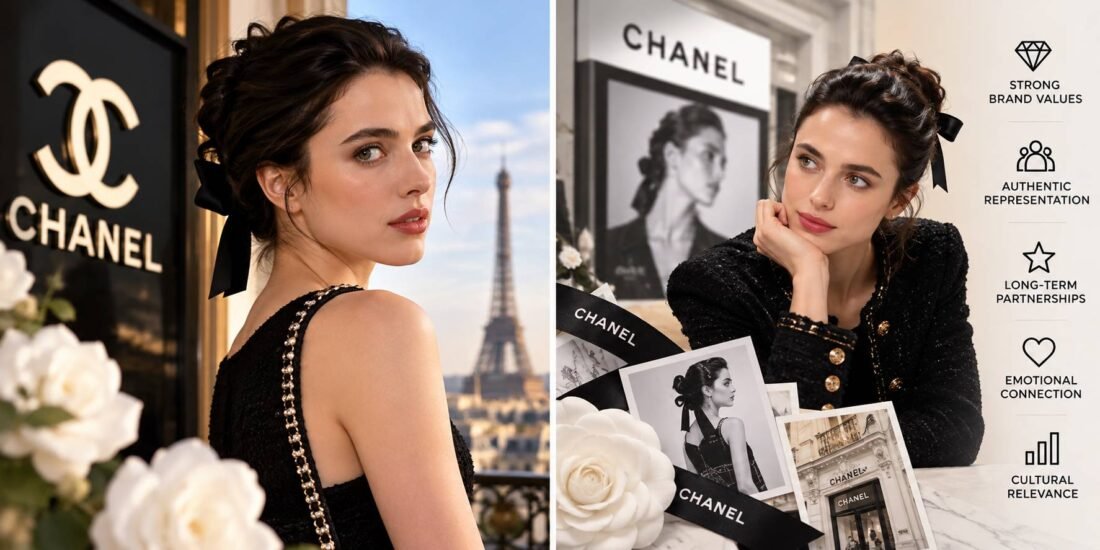
Most celebrity brand deals have the shelf life of a carton of milk. A famous face shows up in a campaign, the photos run for a season, and by next spring everyone has moved on. Margaret Qualley and Chanel are a different story, and that’s exactly why marketers should pay attention.
Qualley first walked for Chanel when she was a teenager. She was named a house ambassador in 2020. Since then she has fronted bag campaigns, beachwear shoots, jewelry ads, couture shows, a short film, and more red carpets than anyone can count. Two creative directors have come and gone in that time. She’s still there.
So what’s actually going on here, and what can a brand that isn’t a 100-year-old Paris fashion house take from it? Quite a lot, it turns out.
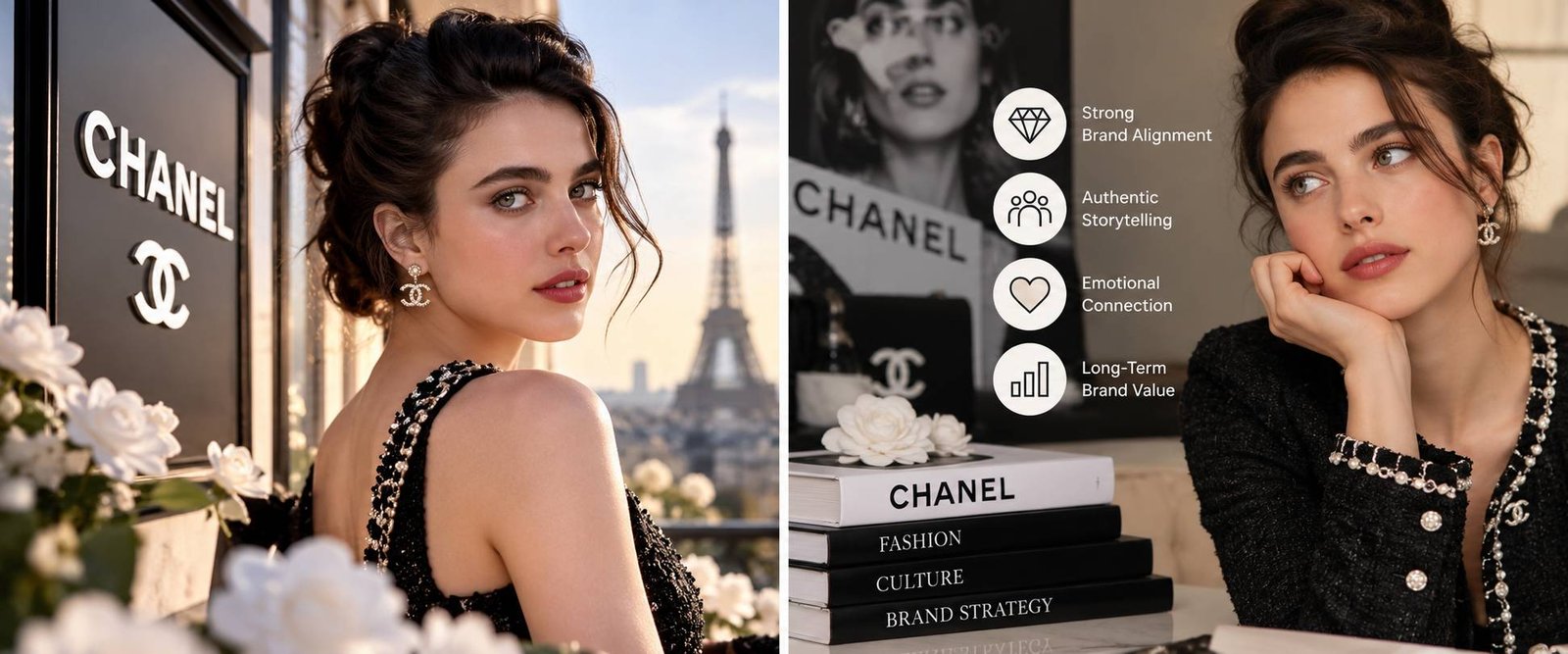
A Quick Timeline of Margaret Qualley and Chanel
Before getting into the lessons, it helps to see how long this relationship has been building. Here’s the short version:
- 2011–2012: At 16, after leaving a serious ballet track, Qualley starts modeling. She walks for Chanel during Paris Fashion Week Spring/Summer 2012 and again for Fall/Winter 2012.
- 2020: Chanel officially names her a house ambassador.
- July 2021: She closes the Fall/Winter 2021 couture show in a floor-length bridal gown and jeweled veil, the traditional “bride” slot that ends a Chanel couture show.
- 2022: She appears in the Chanel 22 bag campaign shot by Inez & Vinoodh alongside Lily-Rose Depp and Whitney Peak, then fronts the Coco Beach summer campaign. She also joins Jennie and Amandla Stenberg for a Coco Crush jewelry campaign.
- August 2023: She wears custom Chanel at her wedding.
- January 2024: She walks the Spring/Summer 2024 couture show after starring in a teaser video with Naomi Campbell.
- Fall 2024: She’s the face of the Fall/Winter 2024 campaign, shot around Paris, with a brand-new bob.
- Late 2025: She stars with A$AP Rocky in a Michel Gondry short film set in New York, teasing Matthieu Blazy’s first Métiers d’Art show for the house.
- 2026: Front row at Blazy’s couture debut in January, Métiers d’Art on the red carpet in February, and a polarizing pair of “barefoot” Chanel sandals at the London premiere of The Dog Stars in August.
That’s fifteen years of history, six of them under contract. Very few brand relationships get anywhere close.
Lesson 1: Pick Someone Whose Story Already Points Toward You
Chanel didn’t discover Margaret Qualley on a list of trending actors. She had walked their runway years before anyone knew her name from Maid, Poor Things or The Substance. By the time the ambassador title came along, the link between the two already felt earned.
That matters more than people think. Audiences are good at sniffing out a paycheck. When a celebrity suddenly “loves” a product they’ve never been seen near, the promotion lands flat. When the history is visible, the partnership reads as a continuation rather than a transaction.
What to borrow: Before you sign anyone, look backward. Has this person already used your product, shown up at your events, or talked about your category on their own? The best brand partners are often people who were halfway there before you called.
Lesson 2: Play the Long Game, Even When Leadership Changes
Here’s the part that impresses me most. Qualley became an ambassador under Virginie Viard. When Matthieu Blazy took over as creative director, Chanel didn’t wipe the slate clean and bring in an entirely new roster. Instead, Qualley was right there in his first big moments: the New York film that teased his Métiers d’Art debut, the front row at his first couture show, and his designs on her red carpets.
That’s smart branding. A new creative director is a moment of risk for any fashion house. Loyal customers wonder if the brand they love is about to change. Putting a familiar face on the new work tells them, quietly, that the house is evolving rather than starting over.
What to borrow: If your company is going through a rebrand, a new product line, or a leadership change, resist the urge to replace everything at once. Keep one or two familiar elements in place. Continuity buys you trust while you experiment.
Lesson 3: Story Beats Product Shots
The late-2025 Michel Gondry film is a great case study. It barely sells anything directly. Qualley wakes up in a small Brooklyn apartment, gets dressed, and takes the subway to work. A$AP Rocky, still in his pajamas, chases her across the city in a sped-up, slightly absurd montage, at one point swimming through the East River. He beats her to Astor Place station, kneels with a little Chanel box, and she leaps into his arms.
Is it an ad? Sure. But it plays like a short romantic comedy, and people shared it because it was fun to watch. The clothes are everywhere, but they never feel like the point.
There was also a bonus round of free promotion. Weeks before the film came out, paparazzi photos of Rocky “proposing” to Qualley outside a subway station spread online and confused a lot of people. Chanel eventually confirmed it was a confidential shoot. Whether that leak was planned or not, it built curiosity that no paid teaser could buy.
What to borrow: Your marketing doesn’t need a famous director. It does need a reason for someone to watch past the first three seconds. Give people a tiny story, a character, a payoff. Let the product ride along.
Lesson 4: One Face, Many Doors
Look at that timeline again. Bags. Swimwear. Fine jewelry. Couture. Ready-to-wear. Shoes. Chanel used the same ambassador to open up very different parts of the business.
That works because Qualley’s image is flexible. She’s a former dancer, a serious actor who takes strange roles, and someone who seems genuinely playful in front of a camera. She can sell a beach cover-up in one campaign and a beaded gown in the next without either one feeling off.
What to borrow: When you pick a partner, think about your whole catalog, not just the product launching this quarter. A person who can credibly represent several lines saves you money, and it keeps your brand voice consistent across categories.
Lesson 5: Treat the Red Carpet as a Media Calendar
Every time Margaret Qualley promotes a movie, Chanel gets a photo op. In 2026 alone that meant the Los Angeles premiere of How to Make a Killing in February and the London premiere of Ridley Scott’s The Dog Stars in August, both in Chanel.
This is a quiet piece of genius. The studio pays for the event. The press shows up for the film. Fashion outlets write their own separate stories about what she wore. Chanel gets earned coverage across entertainment and style media at the same time, and much of the effort is carried by someone else’s marketing budget.
What to borrow: Find out what your partners already have scheduled. Conference talks, product launches, podcast tours, trade shows. Plug your brand into moments that are already going to get attention instead of manufacturing new ones from scratch.
Lesson 6: Let Your Ambassador Carry the Risky Stuff
Those “barefoot” sandals at The Dog Stars premiere were basically a heel and a couple of ankle straps with almost nothing under the front of the foot. They came from Blazy’s Cruise collection and had already gotten people talking. When Qualley wore them in London, the internet split down the middle. Some people loved them. Plenty of others asked whether they even counted as shoes.
From a marketing point of view, that’s not a problem. That’s the job. A divisive design worn by someone people already trust gets a fair hearing. The same sandal on a random model in a lookbook might have been ignored.
What to borrow: Your boldest product shouldn’t be introduced by a stranger. Hand it to the person your audience already likes. They’ll give it a chance, and the debate itself becomes free reach.
Lesson 7: Build an Ensemble, Not a Solo Act
Qualley rarely carries a Chanel campaign alone. She’s been paired with Lily-Rose Depp and Whitney Peak, with Jennie from Blackpink and Amandla Stenberg, and most recently with A$AP Rocky, who was announced as a new ambassador right alongside the Gondry film.
Each pairing pulls in a different crowd. K-pop fans, indie film fans, hip-hop fans, and people who just like a good love story all end up looking at the same campaign. Qualley also acts as a kind of bridge. When a new ambassador debuts next to a familiar one, the newcomer feels like part of the family on day one.
What to borrow: If you work with more than one creator or partner, introduce new ones next to established ones. Collaborations between your own partners are cheap to produce, and they cross-pollinate audiences you’d otherwise pay to reach separately.
What Small Brands Can Actually Do With This
You might be thinking, “Great, but I don’t have Chanel’s budget.” Fair. Nobody does. The principles still scale down surprisingly well.
- Sign longer, smaller deals. A local creator on a 12-month agreement will usually do more for you than a bigger name on a single post.
- Recruit from your own customers. The people who already buy and talk about your product are your version of a teenager who walked the runway years ago.
- Make one fun video instead of five boring ones. A little story with a payoff gets shared. A product demo with stock music rarely does.
- Ride other people’s moments. If your partner is speaking at an event, sponsor their outfit, their booth, or their giveaway.
- Let partners know each other. Get your creators in the same room or the same video. Their audiences will mix.
A Few Honest Caveats
Long-term partnerships aren’t risk-free. When a brand ties itself to a real person for years, it also ties itself to their personal life, their headlines, and their choices. Chanel has handled that by keeping the focus on the work, the films, and the clothes, and by not leaning too hard on any one moment of Qualley’s private life.
Mixed reactions are part of the deal, too. Not everyone liked the sandals. Some viewers found the staged proposal confusing before they knew it was a shoot. A brand that can’t live with a little debate probably shouldn’t pick a partner with a strong personality.
And a long relationship only works if both sides keep it fresh. Part of the reason this one hasn’t gone stale is that Chanel keeps giving Qualley new things to do: a new haircut for the fall campaign, a new director, a new co-star, a new designer’s work to carry.
The Bottom Line
The partnership between Margaret Qualley and Chanel isn’t impressive because of one ad or one dress. It’s impressive because it has lasted, adapted, and stayed interesting for six years in an industry that usually moves on after six months.
Strip away the couture and the Paris backdrops, and the lessons are pretty simple. Choose people with a real connection to what you sell. Stick with them through change. Tell stories instead of listing features. Use the moments they already have. And don’t be afraid to let them carry something that makes people talk.
None of that requires a luxury budget. It just requires patience, which might be the rarest thing in marketing right now.
Published by BrandingX.
Frequently Asked Questions
When did Margaret Qualley become a Chanel ambassador?
She was named a Chanel house ambassador in 2020, though she first walked for the brand in Paris back in 2011 and 2012 as a teenage model.
What Chanel campaigns has Margaret Qualley appeared in?
Her work includes the Chanel 22 bag campaign, Coco Beach 2022, a Coco Crush jewelry campaign, the Fall/Winter 2024 campaign, and a 2025 short film directed by Michel Gondry with A$AP Rocky.
Why do brands use long-term ambassadors instead of one-off celebrity deals?
Long-term partnerships build trust and recognition over time. Audiences are more likely to believe a person who has been connected to a brand for years than someone who appears in a single paid post.
Can small businesses use the same branding strategy?
Yes. Small brands can sign longer deals with micro-creators, recruit partners from their existing customers, and plug into events their partners are already attending.