
Most brand identity advice still starts with the logo. That is the wrong end of the rope. A logo is the receipt you get after the real decisions have been made: who you serve, what you refuse to be, and why anyone should pick you over the six near-identical options sitting one tab away.
And in 2026, those “tabs” are not only browser tabs. A buyer might ask ChatGPT, Gemini or Perplexity to shortlist vendors before they ever see your homepage. So if you are working out how to build a brand identity that survives into 2027, you are designing for two audiences at once: people who feel their way to a decision, and machines that summarise you in three sentences.
We rewrote this guide from scratch for that reality. Below you will find the numbers that matter this year, a ten-step process we use with clients, the trends already forming for 2027, and the mistakes that quietly drain budgets.
Brand identity in 2026: the numbers worth knowing
Before the method, the evidence. These figures come from research published or updated during 2026 unless noted otherwise.
| Finding | Figure | Source |
|---|---|---|
| Combined value of the world’s top 100 brands | $13.1 trillion, up 22% in a year | Kantar BrandZ 2026 |
| Brand value growth for “meaningfully different” brands vs. the rest | 5× faster | Kantar 2026 |
| Companies with a strong brand strategy that beat growth targets | 2× more likely | Gartner 2026 |
| Consumers who call trust an important or critical purchase factor | 88% (quality sits at 89%) | Edelman Trust Barometer 2026 |
| Companies with brand guidelines vs. those that enforce them | 95% vs. 25% | Marq / industry compilations |
| AI users who now begin purchase research on a standalone AI platform | 46%, up from 25% in 2024 | 2026 research summarised by MarTech |
| B2B firms confident they have a clearly differentiated value proposition | Just 4% | Bain & Company 2026 |
Read those rows together and a pattern jumps out. Brands are worth more than ever, trust now weighs almost as much as product quality, yet almost nobody enforces their own rules or feels genuinely distinct. That gap is the opportunity.
What “brand identity” actually covers (and what it doesn’t)
People use brand, brand strategy and brand identity as if they were the same word. They aren’t.
- Brand strategy is the plan: positioning, audience, promise, the reason you exist commercially.
- Brand identity is how that plan becomes visible and audible: name, logo, colour, type, imagery, tone of voice, sound, motion, even the way your support team signs off an email.
- The brand itself is what lives in a customer’s head afterwards. You influence it; you never fully own it.
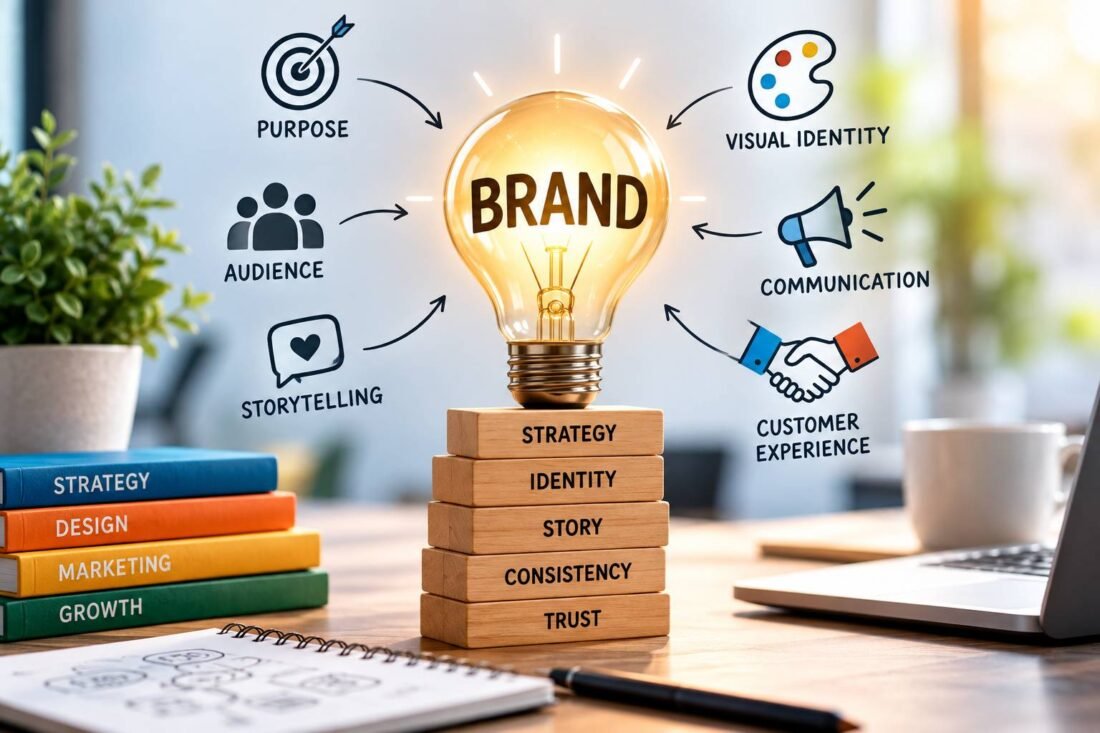
Brand development is the ongoing work of keeping all three aligned as the company grows. Skip the strategy and your identity becomes decoration. Skip the identity and your strategy stays trapped in a slide deck.
How to build a brand identity in 2026: a 10-step method
1. Name the business problem before you open a design file
Is the company entering a new market? Losing pricing power? Being confused with a competitor? Each problem needs a different identity response. Gartner’s 2026 research found that 84% of companies are stuck in what it calls a “brand doom loop”: they underinvest in measuring brand, so they can’t prove its value, so the next budget shrinks. Breaking that loop starts with writing down, in one sentence, what the identity work is meant to change. Professional graphic design services can then help businesses create a consistent visual identity that reflects their brand goals.
A useful test: if your answer is “we want to look more modern,” keep digging. Modern compared to whom, and why does that cost you money today?
2. Write a positioning line you would defend in a pitch
Kantar’s 2026 data shows brands perceived as meaningfully different grow their value five times faster than those that aren’t. Meanwhile Bain found only 4% of B2B leaders feel sure their value proposition is clearly differentiated, even though that confidence tracks with 1.6× faster growth.
So draft a positioning statement that would make at least one competitor uncomfortable. “Quality service at fair prices” fails that test because every rival can say it. “Same-day packaging prototypes for D2C brands under ₹5 crore revenue” passes, because it chooses a customer and excludes others. Your brand strategy lives or dies on that willingness to exclude.
3. Study your audience where they actually decide
Demographics still matter, but behaviour matters more. Where does your buyer go when they are unsure? In 2026 the answer is increasingly an AI assistant. One study summarised by MarTech found 46% of AI users now start purchase research on platforms such as ChatGPT or Perplexity, while the share starting on traditional search dropped from 43% to 24%. A September 2026 Talker Research survey of 2,000 Americans for Spreedly found Gen Z respondents trust ChatGPT more than Google for product research, 31% against 12%.
Practical moves:
- Interview eight to twelve recent customers and ask what they typed, asked or searched before buying.
- Run your category’s top questions through two or three AI assistants and note which brands get named, and how they get described.
- Map competitors’ colours, taglines and tone on a single wall. If everything looks blue and sounds “innovative,” you have found your whitespace.
4. Give the brand a personality with rules attached
“Friendly but professional” is not a personality; it is a shrug. Build a short “we are / we are not” list instead. For example: We are direct, not blunt. Curious, not chatty. Confident, not loud. Then write three sample sentences in that voice: an error message, a sales email opener and a social reply to an angry customer. Tone of voice only becomes real when someone can check a draft against it.
5. Design distinctive assets, not just a logo
This is where brand identity design and visual brand identity come into focus. Researchers at the Ehrenberg-Bass Institute have spent years showing that non-verbal cues (a colour, a shape, a jingle, a character) are what make a brand easy to recall at the moment of choice. Your toolkit should include:
- A primary mark plus a compact version that reads clearly at 16 pixels, because favicons, app icons and AI chat citations display you tiny.
- One ownable colour used with discipline, backed by a supporting palette that passes WCAG contrast checks.
- A type pairing with a clear job for each font.
- An imagery rule: what your photos and illustrations always do, and what they never do.
- Motion and sound cues if video, reels or voice products are part of your mix.
Be careful with changes to assets people already recognise. When Cracker Barrel swapped its long-standing logo in 2025, YouGov polled 1,002 US adults: 65% had noticed the change and 76% preferred the old design. Familiarity is equity. Spend it deliberately.
Quick gut-check: cover your brand name on a social post, a packaging mock-up and a slide. Could a loyal customer still guess it’s you? If not, your assets aren’t distinctive yet.
6. Replace the PDF style guide with a living brand system
Around 95% of companies say they have brand guidelines, yet only about a quarter enforce them, and fewer than one in ten manage high consistency across every channel. The cost is real: Marq’s research found 68% of companies credit brand consistency with 10% to 20% of their revenue growth.
A 60-page PDF nobody opens won’t fix that. What works in 2026:
- Shared design tokens (colour, spacing, type scale) inside Figma and your website codebase.
- Locked templates for decks, social posts and proposals so the sales team can’t “freestyle” the logo.
- A one-page cheat sheet for vendors and freelancers.
- Prompt and reference packs for any AI image or copy tools your team uses, so generated output still looks and sounds like you.
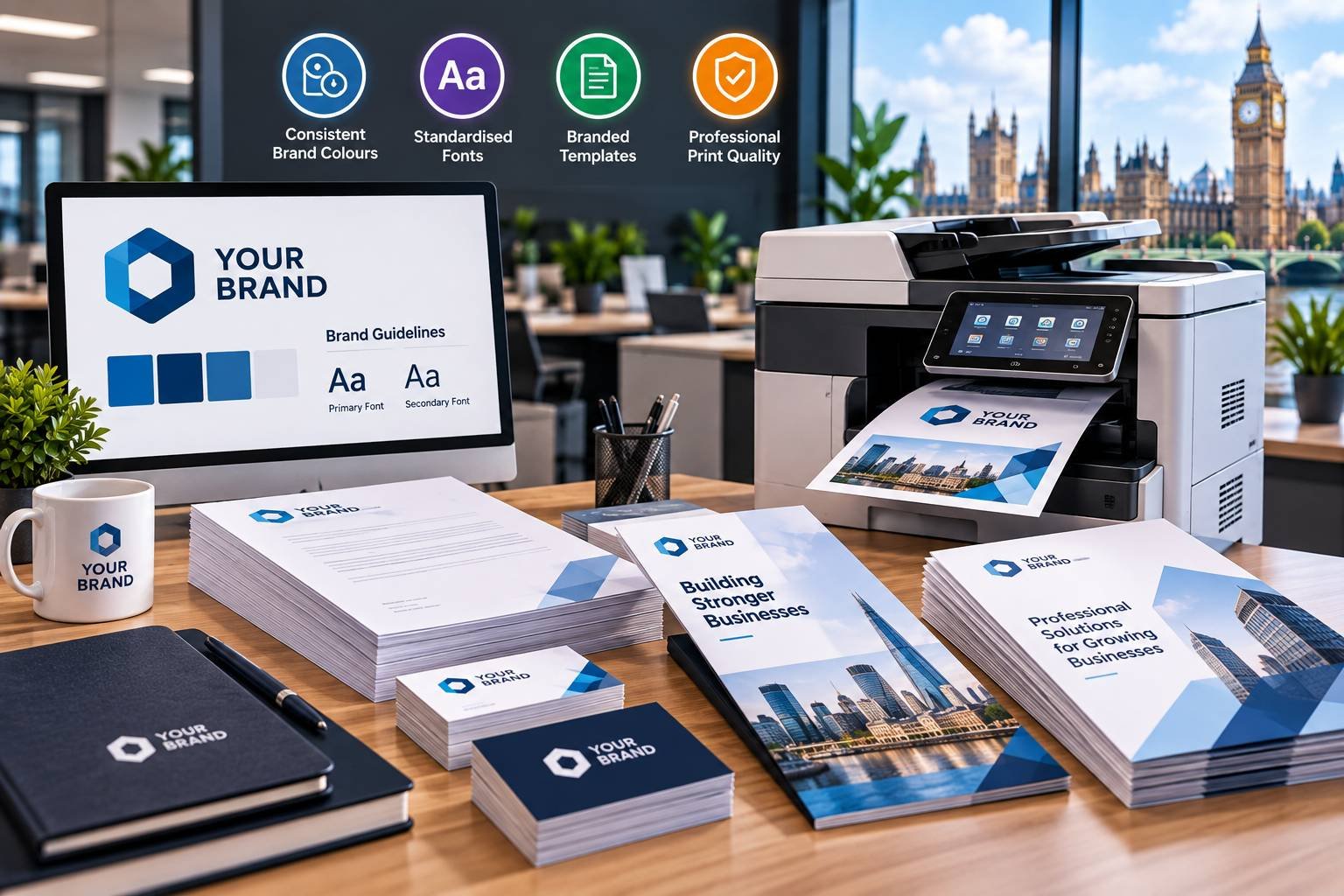
If print matters to your business, our guide on keeping brand consistency across printed documents covers the offline side.
7. Make your brand readable by machines
This step barely existed three years ago. AI assistants now describe your company to prospects, and MarTech’s 2026 roundup reported AI-referred web traffic growing at a 176% compound annual rate while search, social and direct stayed flat. If your descriptions conflict across your site, LinkedIn, directories and press mentions, models will either blur you with competitors or skip you.
- Pick one category descriptor (for example “brand identity studio for SaaS startups”) and repeat it word for word everywhere.
- Add Organization schema to your website with logo, founding date, sameAs links and a concise description.
- Publish clear “what we do / who it’s for / what it costs” pages. Vague pages get paraphrased badly.
- Check monthly how AI tools describe you, and fix the sources feeding them wrong facts.
We cover the technical side in detail on our AI search visibility page.
8. Prove the promise at every touchpoint
Identity breaks most often in places designers never see: the invoice, the delivery SMS, the hold music, the chatbot. Deloitte’s 2026 research found consumers are 20 times more likely than brands to say commerce experiences fall short. Qualtrics adds a sharper warning: roughly 30% of consumers switch after a single bad experience, and only 3 in 10 ever tell the business why they left.
On the upside, Forrester’s 2026 Total Experience study linked strong end-to-end experience to a 3.8× revenue lift for US retailers. Walk your own customer journey once a quarter, from first ad to renewal email, and screenshot every moment that feels off-brand. That list becomes your fix-it backlog.
9. Earn trust inside smaller circles
Edelman’s 2026 Trust Barometer, built on 33,938 respondents across 28 countries, describes a world turning insular: people trust their employer, their peers and their favourite creators far more than distant institutions. For brands, reach alone no longer buys belief.
What does that mean in practice? Fewer, deeper creator partnerships instead of one-off sponsored posts. Customer communities with real access to your team. Case studies with names, numbers and photos of real people. Getty Images survey data cited by Salsify found 98% of consumers say authentic images and video are pivotal to trust, which is a strong argument against filling your site with obviously synthetic stock.
10. Set a baseline, then measure what moved
Pick four or five metrics before launch, not after: aided and unaided awareness, branded search volume, share of voice in AI answers, conversion rate on key pages, and repeat purchase or renewal rate. Record where they stand today. Review at 90 days and again at 12 months. Without a baseline, every rebrand looks either brilliant or pointless depending on who is presenting.
Brand identity trends to plan for in 2027
Human texture as a reaction to AI sameness
As generated imagery floods every feed, expect more grain, hand-drawn marks, imperfect type and real photography. Not nostalgia for its own sake, but proof that a person made choices.
Identity built for AI agents
Agentic shopping is moving from experiment to habit. The Spreedly survey found 63% of Americans would or might let an AI assistant pick brands for them if it reliably saved 20%. When a bot is choosing, structured data, clear pricing and consistent naming become part of your identity.
Continuous transformation over big-bang rebrands
A 2026 WFA and Ogilvy Consulting study found 96% of global brands are in continuous transformation. Gartner predicts more than 80% of companies will significantly change their identity, mission or culture by 2028. Flexible systems that evolve in small steps will age better than dramatic reveals.
Sensory branding moves beyond the screen
Sonic logos, haptic feedback in apps, signature scents in retail and packaging textures are getting serious budgets as brands look for cues that survive outside a feed.
Purpose with receipts
Audiences have grown tired of slogans about values. In 2027 the brands that win on purpose will publish specifics: sourcing data, pay ratios, emission numbers, timelines. Claims without evidence will read as marketing noise.
Five mistakes that quietly weaken a brand identity
- Redesigning when the real problem is the product. A new logo will not fix slow delivery.
- Copying the category leader’s look. You become the cheaper-looking version of someone else.
- Letting every department “adapt” the brand. Five small tweaks add up to a different company.
- Ignoring how AI tools describe you. If you don’t feed them clear facts, they will improvise.
- Launching without a baseline. You lose the ability to prove the work paid off.
For more on getting the strategic foundation right, see our breakdown of branding strategies for startups.
The short version
Knowing how to build a brand identity in 2026 comes down to a few disciplined choices: decide what problem you are solving, stand for something a competitor can’t copy, turn that into assets people recognise without reading your name, and keep every touchpoint, human or machine, telling the same story. Do that, measure it honestly, and your identity becomes something that earns its keep rather than something you redo every three years.
If you would like a second pair of eyes on your current identity, talk to the BrandingX team. We will tell you what is working, what is costing you, and what to fix first.
Frequently Asked Questions
How long does it take to build a brand identity?
For a small or mid-sized business, strategy and core identity usually take six to twelve weeks. Rolling it out across every touchpoint can take another three to six months. Recognition itself builds over years of consistent use.
What are the core elements of a memorable brand identity?
A clear positioning, a distinctive name and mark, an ownable colour, consistent typography, a defined tone of voice and an imagery style. In 2026, add consistent machine-readable information so AI tools describe you correctly.
How much should a small business spend on brand identity design?
Budgets vary widely by market and scope. A focused identity for a startup can cost far less than a full system for a multi-product company. Spend more on strategy and rollout than on logo variations; that is where the return sits.
Should I use AI tools to create my brand identity?
Use AI to explore options, produce variations and speed up production. Keep the decisions human: positioning, final marks and voice. Generated logos also carry trademark and originality risks worth checking with a professional.