
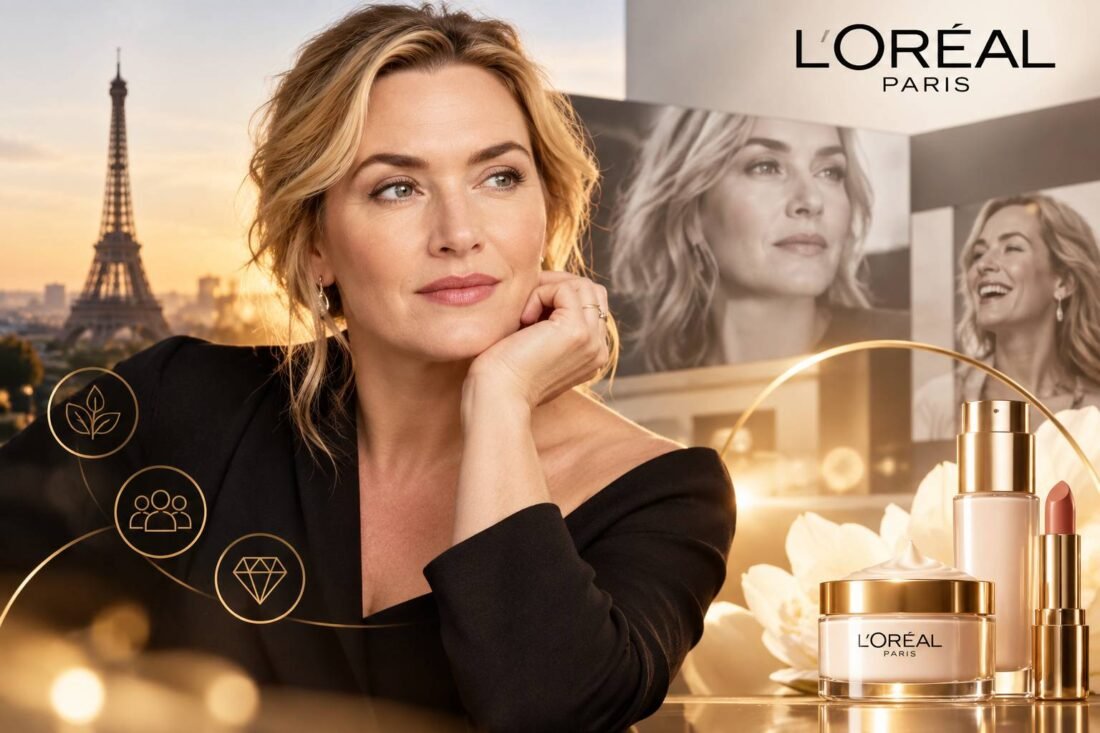
Most celebrity beauty deals follow the same tired script. A famous face, a glossy photo, a product shot, a press release. Fans scroll past them in about two seconds. So when L’Oréal Paris named Kate Winslet a global ambassador in June 2021, plenty of people in marketing expected more of the same.
That is not what happened. The partnership turned into one of the clearest examples of authentic brand marketing in the beauty industry, and it is worth studying closely if you are a marketer, a founder, or anyone responsible for choosing who speaks for your brand.
In this article, we will look at why the Kate Winslet brand ambassador partnership works, how her public views on self worth line up with the oldest message in L’Oréal Paris history, and what companies of any size can learn about choosing ambassadors whose values actually match their marketing goals.
Quick Answer: Why Does This Partnership Matter?
The Kate Winslet and L’Oréal Paris partnership matters because the brand did not have to invent a story for her. Winslet had spent more than a decade speaking publicly about self acceptance, aging honestly, and refusing heavy photo retouching. L’Oréal Paris has built its identity since 1971 around the idea that women are worth it. When a spokesperson’s real track record already matches a brand’s core message, audiences believe the advertising. That alignment is the heart of authentic brand marketing.
How the Kate Winslet Brand Ambassador Deal Came Together
L’Oréal Paris announced Winslet as its newest global ambassador on June 3, 2021. The timing was sharp. She was fresh off the success of Mare of Easttown, a show in which she played a tired, messy, deeply human detective with no Hollywood polish at all. Her first campaign for the brand was for Preference hair color, the same product line where the famous “Because I’m Worth It” tagline was born decades earlier. That detail is easy to miss, but it was a smart, symbolic choice.
In her announcement statement, Winslet said it had taken real effort for her to reach a point where she could make no apology for who she is and accept her flaws. She also admitted that some days you simply do not feel worth it, and that those moments are part of being human. That last part is important. She was not selling perfection. She was selling honesty.
The brand, for its part, described its mission in plain terms: to encourage women to know their worth, celebrate their beauty, and dare to be themselves. It also pointed to Winslet’s habit of telling the stories of overlooked women on screen, such as her role as the fossil hunter Mary Anning in Ammonite. She joined a roster that already included Helen Mirren, Viola Davis, Eva Longoria, and Jane Fonda, many of them women over 40 who are rarely centered in beauty advertising.
The Message L’Oréal Paris Has Been Repeating Since 1971
To understand why Winslet fits, you have to go back to where the brand message started.
In 1971, a 23 year old copywriter named Ilon Specht was working at the McCann agency in New York on a campaign for Preference hair color. The story goes that she was frustrated after a meeting full of men who kept framing the woman in the ad as someone trying to look good for a man. She rewrote the script so the woman was speaking for herself, and it ended with four words: “Because I’m Worth It.”
That line became the backbone of the entire brand. Over the years the pronoun shifted from “I” to “you” and later to “we,” but the idea never changed. L’Oréal Paris says the tagline has been translated into roughly 40 languages and calls it the longest running ad copy in history. In 2025, the brand even released a short documentary, The Final Copy of Ilon Specht, to honor the woman behind it. The film went on to win a Grand Prix at Cannes Lions.
Here is the point for marketers. “Because I’m Worth It” was never just a product claim. It was a statement about self worth, written in the middle of the women’s movement. A brand with a message like that needs ambassadors who can say it without sounding like they are reading a teleprompter.
Kate Winslet’s Public Views on Self Worth Long Before the Contract
This is where the partnership gets interesting. Winslet’s views on self worth were not created for L’Oréal Paris. They were on public record for years.
She Fought Retouching When It Was Not Trendy
Before joining L’Oréal Paris, Winslet spent roughly a decade as the face of Lancôme, which is also owned by the L’Oréal group. In 2015 she revealed that her contract for those ads included a clause banning any retouching of her face. At the time, that was a bold move for a beauty campaign, an industry that had relied on heavy editing for decades.
She Kept Her Wrinkles on the Poster
In 2021, the same year she signed with L’Oréal Paris, Winslet shared that she had sent back a Mare of Easttown poster twice because her wrinkles had been smoothed away. She also turned down an edit to a scene where her stomach was visible. Those are small choices, but they told audiences something real about who she is when no beauty brand is paying her to say it.
She Talks About Aging Without Fear
In interviews over the past several years, Winslet has described getting older as something that can make women feel more powerful, not less. She has said she is more comfortable in her body with each passing year. In late 2025, while promoting her directorial debut Goodbye June, she told a British newspaper she has never had cosmetic work done on her face. She called the growing pressure around injectables and weight loss drugs devastating, and warned that it is frightening when someone’s self esteem depends entirely on their looks.
That is a pretty unusual thing for a beauty ambassador to say out loud. And yet it does not undermine the partnership. If anything, it strengthens it, because it proves she is not a mouthpiece.
Where Her Values and the L’Oréal Paris Message Overlap
When you put Winslet’s track record next to the brand’s message, the overlap is easy to see.
| Kate Winslet’s Public Stance | L’Oréal Paris Brand Message | Why the Fit Works |
|---|---|---|
| Accepting flaws and making no apology for who she is | “Because I’m Worth It” and the mission to help women know their worth | Both center self worth rather than perfection |
| Refusing heavy retouching for over a decade | Celebrating real beauty at every age | Her behavior proves the message instead of just repeating it |
| Speaking openly about aging in the public eye | An ambassador roster that includes many women over 40 and 50 | Speaks directly to an audience that is often ignored |
| Telling the stories of overlooked women on screen | Programs that push women’s visibility, such as Lights on Women at Cannes | Extends the partnership beyond products into purpose |
Notice that none of these overlaps required a marketing team to manufacture anything. They already existed. That is the difference between authentic brand marketing and borrowed credibility.
The Campaigns That Proved the Fit Was Real
A strong announcement is one thing. Sustaining the message over several years is where most ambassador deals fall apart. Two campaigns stand out.
Lessons of Worth (2022)
In early 2022, L’Oréal Paris and McCann Paris launched Lessons of Worth, a series of short films where ambassadors talked about what worth means to them. Winslet’s video stood out because she spent it slowly removing her makeup while she spoke. Think about that for a second. A cosmetics brand let its ambassador take off the product on camera to make a point about self worth. That is a confident brand.
The creative lead behind the series later said each lesson was written together with the spokesperson. That detail matters a lot, and we will come back to it.
Worth It Résumé (2024)
In 2024 the brand launched the Worth It Résumé on LinkedIn, inviting women to list the setbacks that eventually moved them forward. Winslet was among the ambassadors who shared her own version. Putting a beauty campaign on a professional network was an unexpected move, and it showed the brand thinking of worth in terms of careers and resilience, not only appearance.
What Authentic Brand Marketing Actually Means
The phrase gets thrown around a lot, so let’s define it simply.
Authentic brand marketing is marketing where what a brand says matches what it does, and where the people representing it genuinely hold the values being promoted. Audiences can verify it. They can look up an ambassador’s interviews, past work, and social posts and find the same message there that they see in the ad.
Authenticity is not about being casual, unfiltered, or trendy. A polished campaign can be completely authentic. A raw, shaky phone video can be completely fake. What counts is consistency over time between the brand’s promise, the spokesperson’s real life, and the customer’s experience.
Consumers in the USA have become very good at spotting the gap. Most of us have watched a celebrity promote a product they clearly never use, and we remember that feeling. Trust, once lost that way, is hard to win back.
How Companies Can Choose Brand Ambassadors Whose Values Match Their Marketing Goals
Here is the practical part. Whether you are a global beauty company or a regional coffee brand, the same principles behind the Kate Winslet brand ambassador partnership apply.
1. Start With Your Brand Truth, Not the Celebrity
Before you look at a single name, write down the one idea your brand has stood for consistently. For L’Oréal Paris, that is self worth. If you cannot state your own core message in one sentence, no ambassador will fix that. You will just end up renting someone’s fame.
2. Audit Years of Public Record, Not Months
Winslet’s views did not appear in 2021. They were visible in interviews and contract decisions going back years. Look at what a potential ambassador has said and done over a long stretch of time. Read old interviews. Watch how they handled pressure. Values that show up again and again are far more reliable than a single viral moment.
3. Look for Proof in Behavior, Not Just Words
Plenty of celebrities say the right things. Fewer act on them when it costs something. Winslet sending a poster back twice to restore her wrinkles is behavior. Writing a no retouching clause into a beauty contract is behavior. Look for choices that carried real risk or inconvenience, because those reveal what a person truly believes.
4. Match the Ambassador to the Audience You Want to Reach
L’Oréal Paris has a large customer base of women over 40, a group many beauty brands ignored for years. Choosing Winslet, Mirren, Davis, and Fonda speaks directly to that audience. Ask yourself who you want to feel seen by your campaign, then find someone they already trust and relate to.
5. Give Your Ambassador a Real Voice
Remember the detail about Lessons of Worth being written together with each spokesperson? That is how you keep authenticity from turning into a script. When ambassadors help shape the message, it sounds like them. When legal and marketing teams write every word, audiences can tell.
6. Expect and Accept Some Tension
Winslet has publicly criticized parts of the beauty culture that sells cosmetic perfection. A nervous brand might see that as a risk. A confident brand sees it as credibility. If your ambassador agrees with you on every single point, they may just be agreeing with whoever pays them. Some honest friction can make the partnership more believable.
7. Think Long Term and Measure Beyond Reach
One campaign rarely builds trust. The Winslet partnership has stretched across several campaigns and years, each one reinforcing the same idea. When you measure success, look past impressions and follower counts. Track brand sentiment, message recall, and whether people associate your ambassador with your values instead of only your product.
A Simple Ambassador Fit Checklist
Use these questions before signing anyone to represent your brand:
- Does this person’s public history support our core brand message without any spin?
- Have they acted on these values when it was inconvenient or unpopular?
- Does our target customer already trust and relate to them?
- Will they help shape the campaign, or only appear in it?
- Could we defend this partnership if a journalist dug into their past statements?
- Are we prepared to work with them for several years rather than one season?
If you are answering “no” or “not sure” to more than one or two, keep looking.
The Honest Tension in This Partnership
It would be dishonest to pretend there is no contradiction here. L’Oréal Paris sells makeup, hair color, and skincare. Winslet says beauty comes from within and warns against tying self esteem to appearance. Some critics will always see that as a mismatch.
But the way the partnership handles it is instructive. The brand frames its products as a choice and a form of self expression, not as a fix for something broken. Winslet has talked openly about how she uses makeup, including mixing foundation shades as her skin changes. She is not anti makeup. She is anti shame. That nuance lets both sides stay honest, and it is a useful model for any brand whose product could be seen as conflicting with an ambassador’s values.
Lessons for Small and Midsize Brands
You do not need an Oscar winner to apply any of this. A local fitness studio can partner with a member whose story genuinely reflects its values. A sustainable clothing company can work with a creator who has lived low waste for years, not one who discovered it last month. A small skincare brand can pick a micro influencer with 15,000 loyal followers who trust her recommendations, over a big name with millions of followers who will forget the product next week.
The scale is different. The principle is identical. Choose people whose real lives already say what your brand wants to say.
Key Takeaways
- The Kate Winslet brand ambassador partnership works because her public record on self worth existed long before the contract.
- L’Oréal Paris has repeated the same core message since 1971, which makes value alignment easier to judge.
- Authentic brand marketing depends on consistency between a brand’s promise, its spokesperson’s real behavior, and the customer’s experience.
- Look for proof in actions, especially ones that carried a cost, rather than polished statements.
- Let ambassadors help shape the message so it sounds like them.
- Honest tension can increase credibility when it is handled openly.
Also Read: What Brands Can Learn from Margaret Qualley’s Partnership with Chanel
Final Thoughts
The Kate Winslet brand ambassador story is not remarkable because it is glamorous. It is remarkable because it is believable. A brand that has spent more than 50 years telling women they are worth it found a spokesperson who had already been living that message in public, sometimes at her own professional expense.
That is the real lesson for anyone building a brand today. Do not hire a face to carry your message. Find someone who has been carrying it all along.
Published by BrandingX.
Frequently Asked Questions
When did Kate Winslet become a L'Oréal Paris brand ambassador?
L'Oréal Paris announced Kate Winslet as a global ambassador on June 3, 2021. Her first campaign was for Preference hair color, the same line that introduced the "Because I'm Worth It" tagline in 1971.
Why did L'Oréal Paris choose Kate Winslet?
The brand chose Winslet because her public values already matched its mission of helping women know their worth. She had spoken for years about accepting her flaws, aging naturally, and refusing heavy retouching, and she often plays women whose stories have been overlooked.
What is the meaning of "Because I'm Worth It"?
The tagline was written in 1971 by copywriter Ilon Specht. It was designed so that the woman in the ad spoke for herself and chose a product because she valued herself, not to please anyone else. It has since become a broader statement about self worth.
Did Kate Winslet ban retouching in her beauty contracts?
Yes. In 2015, while working with Lancôme, Winslet revealed that her contract included a clause preventing any retouching of her face in the ads. She has continued to push back against heavy editing in her film and TV work.
What is authentic brand marketing?
Authentic brand marketing is an approach where a brand's message matches its actions and where the people representing it genuinely share its values. Customers can check the claims against real behavior and find them consistent.
How should a company choose a brand ambassador?
Start with your core brand message, then look for people whose public history supports it over many years. Prioritize proof in behavior, match the ambassador to your target audience, give them a voice in the creative work, and plan for a long term relationship.
Can small businesses use the same approach as L'Oréal Paris?
Yes. Small and midsize brands can partner with local figures, customers, or micro influencers whose real lives reflect the brand's values. Trust and relevance often matter more than follower count.