


More and more brands have incorporated artificial intelligence (AI) tools into their own workflows. This is due to the fast-paced system requirements for industries nowadays, where customers are more likely to look for more efficient solutions. But in using AI to work in fields where even a minor error can affect a legal outcome, financial decision, or worse, a patient’s health or life, users are more cautious about the tools they use.
Based on observations, users tend to trust AI tools more when they are transparent about how they work as well as their limitations. More importantly, customers look to tools that are more likely to be adaptable with human verification. The brands that become successful with integrating AI systems within their systems will therefore combine clear positioning, transparent evidence, honestly defined limitations, and meaningful human oversight in their campaigns.
This article seeks to discuss these principles in a practical AI product brand strategy that aims to gain a customer’s confidence before, during, and after every interaction on their chosen platforms.
Why Trust Matters More for High-Stakes AI Brands
Trust matters because it decides whether your customers continue using your products and services for a long time or whether they are merely there to experiment.
In industries that are high stakes, people are not only looking for which tool is useful. They are more concerned with asking whether it is reliable enough to support a legal, financial, or health-related decision, all of which involve high risks if erroneous.
It must be emphasised that trustworthy AI tools must be reliable, safe, and accountable. As such, ensure that your brand reflects these values in order to gain your customers’ trust.
Illustration of an Unsupported Claim
DoNotPay, a UK-based legal services firm which is dubbed the world’s first robot lawyer, illustrates the risk. The company marketed its service as “the world’s first robot lawyer” and claimed it could generate valid legal documents and substitute for a lawyer’s expertise, while allegedly failing to test whether its outputs actually met the verification and responsibility standards within the legal system.
Here, the Federal Trade Commission prohibited them from ever advertising themselves as the “world’s first robot lawyer” as it leads to essentially claiming to substitute for a human professional without competent evidence.
For a high-stakes AI company brand such as this, the lesson is clear: never position the product as a replacement for professional judgment unless you can substantiate that claim.
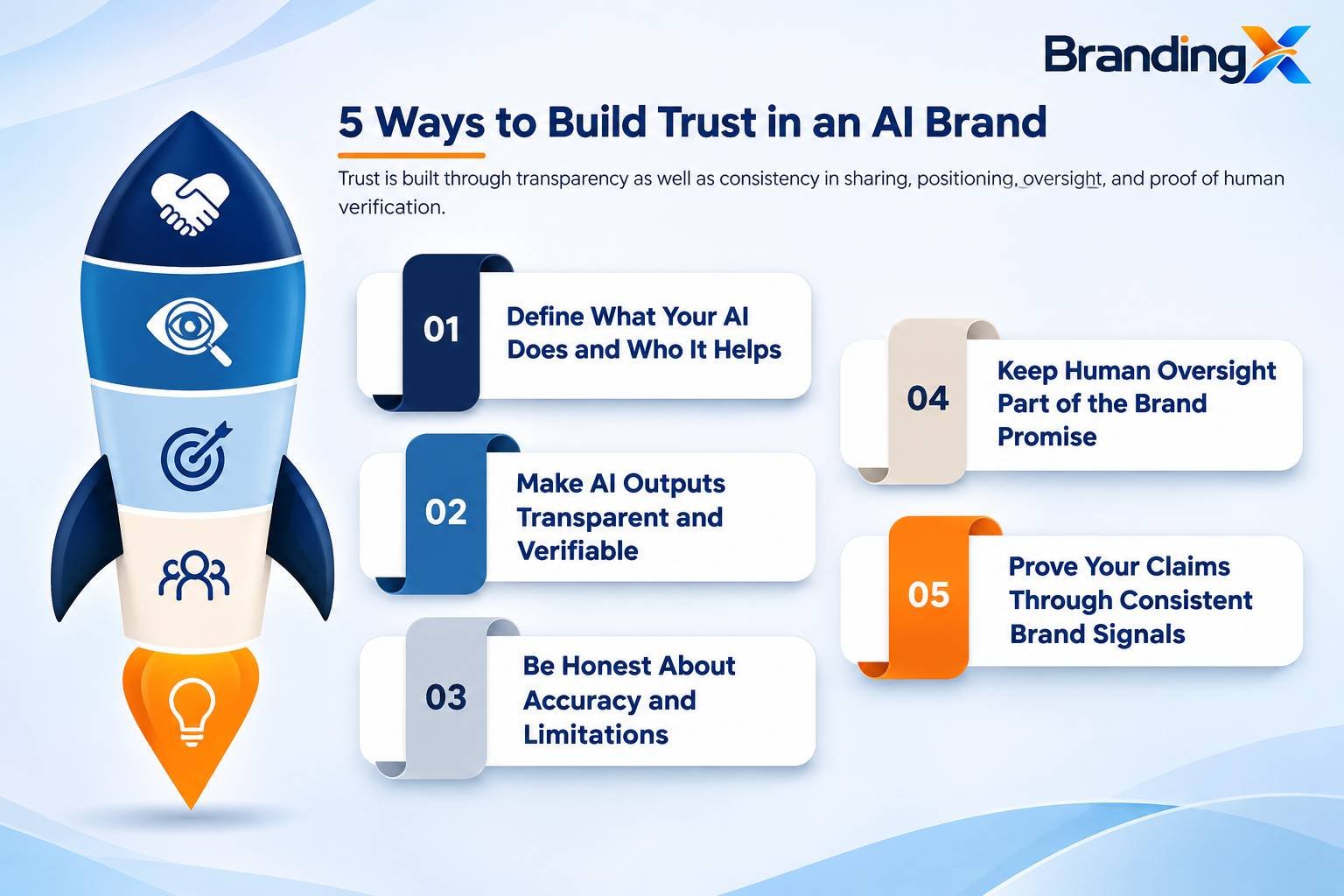
5 Ways to Build Trust in an AI Brand
Customer trust can be built through transparency as well as accountability in brand positioning. Another feature to develop is to express your products’ adaptability with human verification.
These brand angles can be reflected through both product design and public communication on your chosen platforms. Other ways to build customer trust through your brand positioning are the following:
1. Define What Your AI Product Does and Who It Helps
Strong brand positioning and customer trust building starts with identifying your target audience. After identifying who you want to cater to, pinpoint what problem they seem to have with their current product options.
Instead of simply claiming to offer “revolutionary AI” or “companion intelligence for everyone,” explain exactly and with specificity who the product serves, what workflow it is most appropriate for, and what outcomes it produces. This way, your customers would find their easiest way to you.
2. Make AI Outputs Transparent and Verifiable
Customers should be able to inspect not only an AI answer, but also the basis for such results. This is where citations come into play. Transparency means making relevant information about the system and its outputs available to users, while explainability helps users understand how and why the system produced a result. This includes following the cited sources and reading the source material yourself.
Some more practical ways to make your products more verifiable include:
- Linking claims to original sources, citations, documents, or data.
- Showing retrieval evidence, such as the passages used to generate an answer.
- Making documentation available in plain language for the intended user.
3. Be Honest About Accuracy and Limitations
Another way to gain customer trust is to avoid claiming that your outputs are always accurate. It is common knowledge that generative AI systems can produce incomplete or fabricated information due to hallucinations.
As such, it is important to let your customers know of these risks before claiming that your product is trying its best to be open to human verification. In that manner, customers would feel more participative in the whole AI process.
4. Keep Human Oversight Part of the Brand Promise
It cannot be emphasised enough that human verification should be built into the product workflow of any AI brand. Unlike accuracy, human verification should be communicated as part of the brand promise to gain customer trust.
In high-stakes industries particularly, AI can accelerate research and summarise information for you, but it should also position itself as merely a companion, and not a replacement for professional judgment when and where required.
Responsible AI brand workflows often include:
- Clear accountability steps for high-impact decisions.
- Editable outputs with visible sources and change history.
- Defined accountability for the final decision.
5. Prove Your Claims Through Consistent Brand Signals
Customer trust tends to grow when the brand’s promises are supported by consistent signals across their product, website, and customer interactions.
As such, your brand’s trust claims should not appear only on the landing page once, but they should be visible all across your platform, ensuring that your customers know about your company’s commitment to building products they can rely on.
What Legal AI Can Teach Businesses About Building Trust
Legal AI tools should be able to demonstrate how customer trust can be operationalised rather than merely promised through your platform. Since legal research carries direct, and sometimes serious, consequences for your customers, your product must make its position verifiable and its sources accessible.
CaseChat is one example of an AI-powered legal research platform that connects AI-assisted research with case law and legislation. It also allows users to move from an AI-generated answer to the underlying authorities on their own, expanding its brand’s customer trust.
Other values your brand can focus on to increase customer trust are the following:
Traceability
A trustworthy legal AI answer from a company only becomes transparent when it connects each of its claims to the source material, whether a whole case, statute, regulation, or judgment, that supports it, so users can trace the answer back to its source and verify it themselves.
CaseChat illustrates this approach: its AI-assisted research provides answers grounded in legal authorities, with linked citations and source materials from its case law database that users can review for themselves.
Specificity
Aside from answers that are isolated results, general answers are likewise difficult to trust, especially in high-stakes work. In legal research, the difference between a case and legislation, between binding and persuasive authority, and between one jurisdiction and another can determine whether an answer is useful to your customer at all.
CaseChat supports this specificity through jurisdiction and court-level filtering, as well as access to cases and legislation across Australian, New Zealand, and UK sources depending on the tier you want to avail.
Verification
Trust is heightened if the product advocates for human validation rather than simply soliciting it. For example, an aspect of a legal research product that should be intuitive is to allow the user to open up the original opinion or legislation library, verify the passage is supported by the summary, and review the authority to determine if it is up to date.
CaseChat also helps its users verify AI-generated answers by accessing the original case law or legislation through the platform’s citations.
Accountability
Lastly, AI tools should position themselves as merely a research companion. They are not a substitute for legal human judgment. A human legal professional should remain responsible for assessing relevance and making the final recommendation.
CaseChat is a research and analysis tool that supports legal work rather than replacing professional legal judgment or providing legal advice. That distinction should appear throughout the product and marketing: in onboarding, output labels, disclaimers, review workflows, and sales conversations.
A Practical Checklist for Launching a Trustworthy AI Brand
To start launching (or rebranding) your business, you can check and answer these five questions to get you started:
- Is the target user and intended use clear? With this question, you can define exactly who the product serves and the main problem it solves. Aside from the user and the problem, you can also determine which work processes your product works best for.
- Are product capabilities and limitations disclosed? Through your brand positioning, clearly explain what your AI product can do and its limitations. It is important to be transparent about your limitations while aiming to position your product strongly.
- Can users verify important outputs? Make sure to provide your users with source materials and citations so they can verify the information themselves.
Final Thoughts on Building Trust in AI
The way to build a trustworthy AI brand in a high-risk industry like the legal and financial industries requires more than just sound campaigning and brand positioning. A customer base built on trust comes from transparent, accountable campaigns, truthful claims about limitations, and effective human checks. As such, you can be certain to build a product, brand, or service that reflects your organisation’s values.