
Keyword research used to be simple. You found a phrase with decent search volume, checked the competition, wrote a page and waited for rankings. That playbook still matters, but it no longer tells the whole story. Google AI Overviews now answer millions of queries before a single organic link is clicked. ChatGPT Search, Perplexity AI, Bing Copilot and Gemini answer questions in full sentences, citing a handful of sources rather than listing ten blue links. If your content is not one of those cited sources, you are invisible to a growing share of searchers.
This is where Answer Engine Optimization (AEO) comes in, and it changes what we ask of keyword research tools. Instead of only hunting for high volume head terms, we now need to uncover the actual questions people ask, the conversational queries they speak into voice assistants, the entities search engines associate with a topic, and the content structures that AI systems prefer to quote.
In this guide, written from the perspective of a working SEO consultant, I will walk you through how keyword research has evolved, what makes a tool genuinely useful for AEO, and detailed reviews of the keyword research tools I use and recommend. I will also share a practical workflow, common mistakes, and honest opinions on where each tool earns its keep. One point I want to make upfront: no single tool is perfect. The best results always come from combining two or three tools that cover each other’s blind spots.
What is AEO (Answer Engine Optimization)?
Answer Engine Optimization is the practice of structuring and optimising content so that answer engines can extract, cite and present it as a direct response to a user’s question. Answer engines include Google AI Overviews, featured snippets, People Also Ask boxes, voice assistants, and conversational AI platforms such as ChatGPT Search, Perplexity AI, Bing Copilot and Gemini.
Where traditional SEO aims to rank a page in a list of results, AEO aims to make your content the answer itself. That distinction matters because answer engines behave differently from classic search:
- They favour clear, direct answers placed near the top of a section.
- They rely heavily on question-based content and structured data.
- They evaluate entities and topical authority, not just individual keywords.
- They often produce zero-click searches, where the user never visits a website at all.
AEO does not replace SEO. It sits on top of it. A page that ranks nowhere will rarely be cited by an AI system, so the fundamentals of search intent, quality content and technical health still apply. AEO simply adds a layer: your content must be quotable, well structured and semantically complete.
Why Keyword Research Is Changing in the AI Era
Three shifts are forcing keyword research to evolve.
1. Queries are becoming conversational
People no longer type “best CRM small business”. They ask, “Which CRM should a five person agency use if we mostly need email tracking?” Voice search and chat interfaces encourage full sentences, follow-up questions and context. Traditional keyword databases, built around short typed phrases, capture only a fraction of this behaviour. AEO keyword research must therefore prioritise question keywords, long-tail keywords and natural language variations.
2. Search engines think in entities and topics
Modern semantic search does not match strings; it matches meaning. Google’s Knowledge Graph and the language models behind AI search understand that “keyword difficulty”, “SERP competition” and “ranking difficulty” describe the same concept. This is why entity SEO and topical authority now matter more than exact match phrases. A site that covers a topic comprehensively, with well connected content clusters, is far more likely to be cited by AI systems than a site with one isolated article.
3. Zero-click results are the norm for informational queries
Featured snippets, People Also Ask, AI Overviews and chat answers resolve many queries on the results page. Fighting this trend is pointless. The smarter response is to become the source those features quote, which builds brand visibility, trust and eventually clicks on the commercial queries that still drive traffic.
Traditional SEO vs AEO Keyword Research
The core skills overlap, but the emphasis shifts considerably. Here is how I explain the difference to clients:
| Aspect | Traditional SEO keyword research | AEO keyword research |
|---|---|---|
| Primary target | Head terms and mid-tail phrases with measurable search volume | Questions, conversational queries and long-tail variations, often with low or no reported volume |
| Key metrics | Search volume, keyword difficulty, CPC | Question coverage, SERP features present, entity relationships, snippet ownership |
| Unit of planning | One keyword, one page | One topic cluster, many interlinked answers |
| Success measure | Ranking position and organic clicks | Citations in AI Overviews and chat answers, snippet wins, brand mentions, plus rankings |
| Content format | Long articles optimised for a target phrase | Structured content with direct answers, FAQs, definitions, tables and schema markup |
| Intent focus | Broad intent categories | Granular search intent, including follow-up and comparison questions |
In practice, I run both processes together. Traditional metrics tell me where the commercial value sits. AEO research tells me how to structure the content so it wins visibility in AI search as well as classic rankings.
What Makes a Good AEO Keyword Research Tool?
When I evaluate keyword research tools for AEO work, I look for six capabilities:
- Question discovery. Can the tool surface real questions, including People Also Ask data and autocomplete questions?
- SERP feature visibility. Does it show which keywords trigger featured snippets, AI Overviews or PAA boxes?
- Intent classification. Does it help you separate informational, commercial, navigational and transactional intent?
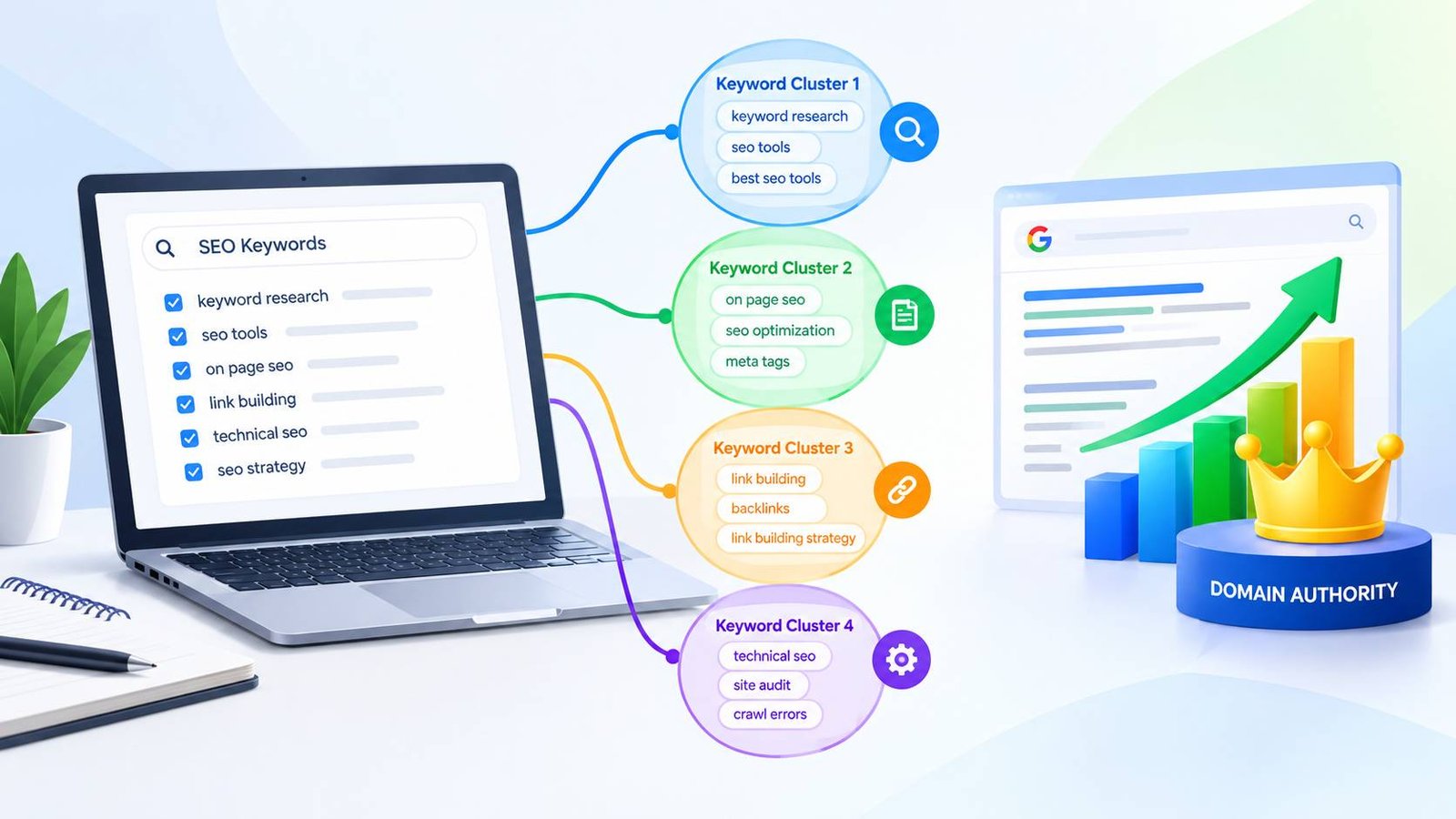
- Clustering and topic mapping. Can it group keywords into clusters so you can plan topical authority rather than isolated pages?
- Conversational and trend data. Does it capture how people phrase queries in chat and voice, and how demand is shifting?
- Honest data at your budget. Volume and keyword difficulty numbers are estimates everywhere. A good tool is transparent about that and priced sensibly for your use.
No tool scores top marks on all six, which is exactly why the workflow later in this article combines several.
The Best Keyword Research Tools for AEO
Below are the tools I actually use with clients, grouped roughly from free foundations to specialist and AI-powered options. Pricing changes often, so treat the figures as approximate and check each vendor’s site before committing.
1. Google Search Console
Overview: Google Search Console (GSC) shows the real queries your site already appears for, including impressions, clicks and average position. It is first-party data straight from Google, which makes it the most truthful dataset you will ever own.
- Best use cases: Finding question keywords you already rank for on page two, spotting queries with high impressions but low clicks, and identifying pages losing visibility as AI Overviews expand.
- Advantages: Free, accurate, and full of long-tail and conversational queries no third-party database captures.
- Limitations: Only covers your own site, hides some queries for privacy, and offers no competitor data or difficulty scores.
- Pricing: Free.
- AEO usefulness: Excellent. Filter queries containing “how”, “what”, “why”, “can” or “vs” to build an instant question keyword list your site is already trusted for.
- Best suited for: Everyone. There is no scenario where GSC should not be part of your workflow.
- Expert tip: Export twelve months of query data and run a regex filter for question words. Pages ranking positions 4 to 15 for questions are your fastest AEO wins; restructure them with a direct answer at the top.
2. Google Keyword Planner
Overview: Built for Google Ads, Keyword Planner remains a useful source of search volume ranges and keyword ideas drawn directly from Google’s own data.
- Best use cases: Validating whether a topic has commercial demand and gathering seed keywords for a new niche.
- Advantages: Free with a Google Ads account, and its data comes from the source.
- Limitations: Volume ranges are broad unless you run ads, it groups similar keywords together, and it surfaces very few question keywords.
- Pricing: Free.
- AEO usefulness: Modest. Use it for demand validation, not question discovery.
- Best suited for: Business owners and beginners validating a niche before investing in paid tools.
- Expert tip: Enter a competitor’s URL instead of a keyword to extract the themes Google associates with their site.
3. Google Trends
Overview: Google Trends shows relative search interest over time, by region, and across related topics and queries.
- Best use cases: Spotting rising conversational queries, comparing entity popularity, and timing seasonal content.
- Advantages: Free, real-time, and one of the few tools that reveals momentum rather than static volume.
- Limitations: Relative data only, with no absolute volumes or difficulty metrics.
- Pricing: Free.
- AEO usefulness: Good. The “related queries” panel, especially the “breakout” items, often reveals new questions before they appear in any keyword database.
- Best suited for: Content creators and marketers planning timely, trend-aware content.
- Expert tip: Compare your target topic as a “search term” and as a “topic” (entity). If the entity trends strongly while your term does not, you may be using the wrong vocabulary for your audience.
4. Semrush
Overview: Semrush is a full marketing suite with one of the largest keyword databases available. Its Keyword Magic Tool, intent labels and SERP feature filters make it a serious AEO workhorse.
- Best use cases: Large-scale question mining, competitor gap analysis, keyword clustering via its Keyword Strategy Builder, and tracking which keywords trigger AI Overviews and featured snippets.
- Advantages: Question filters, intent classification, SERP feature data, position tracking for snippet ownership, and strong reporting for agencies.
- Limitations: Expensive for solo users, and the interface can overwhelm beginners. Volume figures, as with all third-party tools, are estimates.
- Pricing: From roughly $140 per month, with a limited free tier.
- AEO usefulness: Excellent. Filtering the Keyword Magic Tool by “Questions” plus the featured snippet or AI Overview SERP feature is one of the fastest ways to build an AEO target list.
- Best suited for: Agencies, in-house teams and professionals managing multiple projects.
- Expert tip: In position tracking, tag keywords where competitors own the featured snippet. Rewriting your answer paragraph to be more direct than theirs is often enough to take it.
5. Ahrefs
Overview: Ahrefs pairs an enormous backlink index with a polished keyword research module. Keywords Explorer, the Matching Terms question filter and the Content Gap report are staples of my process.
- Best use cases: Assessing keyword difficulty realistically, finding questions competitors answer that you do not, and analysing the “Also rank for” and “Also talk about” reports for entity relationships.
- Advantages: Reliable difficulty scoring tied to link data, clean UX, strong parent topic grouping, and SERP overviews showing which features appear for each keyword.
- Limitations: Costly, with credit limits on lower plans that heavy researchers will feel quickly.
- Pricing: From roughly $129 per month, plus free Ahrefs Webmaster Tools for your own verified sites.
- AEO usefulness: Excellent. The parent topic concept helps you decide whether a question deserves its own page or a section within a pillar, which is central to topical authority planning.
- Best suited for: SEO professionals who want dependable competitive data alongside keyword research.
- Expert tip: Run Content Gap against three competitors, then filter the results to questions only. This produces a ready-made FAQ and supporting article roadmap in minutes.
You May Like: Surfer SEO vs Ahrefs
6. SE Ranking
Overview: SE Ranking offers most of what the premium suites do, including keyword research, clustering, rank tracking and an increasingly capable AI results tracker, at a friendlier price.
- Best use cases: Small agencies and businesses that need clustering, SERP feature tracking and competitor research without enterprise pricing.
- Advantages: Strong value, built-in keyword clustering, flexible plans, and tracking for AI Overview presence.
- Limitations: Smaller database than Semrush or Ahrefs, and fewer advanced filters.
- Pricing: From roughly $65 per month.
- AEO usefulness: Very good for the price, particularly its clustering, which groups keywords by actual SERP similarity rather than word overlap.
- Best suited for: Budget-conscious professionals and growing agencies.
- Expert tip: Use SERP-based clustering before writing anything. If two questions share the same top results, answer both on one page rather than splitting them.
7. Moz Keyword Explorer
Overview: Moz’s Keyword Explorer is known for its Priority score, which blends volume, difficulty and expected click-through into a single number, useful when SERP features soak up clicks.
- Best use cases: Prioritising keywords where organic clicks are still available despite zero-click searches, and beginner-friendly research.
- Advantages: Organic CTR estimates, clear interface, generous free queries each month, and solid question suggestions.
- Limitations: Smaller index and slower feature development than rivals.
- Pricing: Free limited queries; Moz Pro from roughly $99 per month.
- AEO usefulness: Good. The organic CTR metric is a quiet AEO gem, flagging queries where answer boxes dominate so you can decide whether to chase the snippet or skip the keyword.
- Best suited for: Beginners and marketers who want guided prioritisation.
- Expert tip: Low organic CTR plus high volume usually means an answer feature owns the SERP. Target it only if you intend to win that feature.
8. KeywordTool.io
Overview: KeywordTool.io scrapes autocomplete suggestions from Google, YouTube, Bing, Amazon, Instagram and app stores, producing hundreds of long-tail variations per seed.
- Best use cases: Platform-specific research, especially YouTube and Amazon, and bulk long-tail expansion.
- Advantages: Multi-platform coverage, question tab, works without an account for basic suggestions.
- Limitations: Volume and CPC data sit behind the paid plan, and there is no difficulty or SERP analysis.
- Pricing: Free suggestions; paid plans from roughly $89 per month.
- AEO usefulness: Moderate. Autocomplete reflects real phrasing, which helps you mirror conversational queries, but you will need another tool for validation.
- Best suited for: Content creators working across multiple platforms.
- Expert tip: Use the YouTube mode to find question phrasing for video, then answer the same questions in written form with schema markup for double coverage.
9. AnswerThePublic
Overview: AnswerThePublic visualises autocomplete data as question wheels, prepositions and comparisons, turning a seed keyword into a map of public curiosity.
- Best use cases: Brainstorming FAQ sections, ideating supporting articles, and presenting question landscapes to clients.
- Advantages: Fast, visual, and organised by question type (who, what, why, how, can, will, vs).
- Limitations: No reliable volume or difficulty data, limited free searches, and some suggestions are noise.
- Pricing: Limited free searches daily; paid plans from roughly $11 per month.
- AEO usefulness: Very good for ideation. Its output maps almost directly onto FAQ content and People Also Ask targeting.
- Best suited for: Content creators, small businesses and anyone starting AEO question research.
- Expert tip: Export the full list, paste it into a spreadsheet, and validate the promising questions against GSC and Semrush or Ahrefs before writing.
10. AlsoAsked
Overview: AlsoAsked pulls live People Also Ask data and, crucially, shows how questions branch into follow-up questions, revealing how Google models the journey through a topic.
- Best use cases: Structuring pillar pages and FAQ hierarchies, and understanding follow-up intent for conversational content.
- Advantages: Shows question relationships rather than flat lists, uses live PAA data, and exports cleanly.
- Limitations: Narrow focus, no volume data, and limited free searches.
- Pricing: A few free searches monthly; paid plans from roughly $15 per month.
- AEO usefulness: Excellent. The branching structure is effectively a blueprint for how an AI assistant might walk a user through a topic; mirror it in your headings.
- Best suited for: Content strategists building topic clusters and pillar content.
- Expert tip: Use second and third level questions as H3 headings beneath a primary H2 question. This matches how answer engines chunk and retrieve content.
11. LowFruits
Overview: LowFruits finds long-tail keywords where weak sites (forums, UGC, low authority domains) already rank, signalling opportunities that modest sites can win.
- Best use cases: New or low authority websites hunting winnable question keywords.
- Advantages: SERP weakness analysis, pay-as-you-go credits, question extraction, and clustering.
- Limitations: Analysis consumes credits, and the interface is more functional than beautiful.
- Pricing: Credit based, from roughly $25 for 2,000 credits, with no subscription required.
- AEO usefulness: Very good. Weak SERPs full of forum results are exactly where a well structured, direct answer can rank quickly and get cited by AI systems.
- Best suited for: Niche site builders, bloggers and small businesses.
- Expert tip: When LowFruits flags Reddit or Quora ranking for a question, read those threads. They contain the exact vocabulary and sub-questions your answer should cover.
12. Keywords Everywhere
Overview: A browser extension that overlays volume, CPC, competition and trend data directly onto Google, YouTube and other sites as you browse.
- Best use cases: Instant validation while researching in the SERP, and enriching People Also Ask and autocomplete data in place.
- Advantages: Extremely cheap, frictionless, and shows related keywords and questions on every results page.
- Limitations: Not a standalone research platform; data depth is limited.
- Pricing: Credit based, starting at a few dollars per month.
- AEO usefulness: Good as a companion. Seeing volume next to PAA questions while you browse speeds up manual SERP analysis considerably.
- Best suited for: Freelancers and anyone doing hands-on SERP research.
- Expert tip: Pair it with manual searches of your target questions. The combination of live SERP observation plus on-page metrics beats spreadsheet-only research for AEO.
- Website: keywordseverywhere.com
13. Exploding Topics
Overview: Exploding Topics identifies terms and entities gaining momentum before they become competitive, using search and social signals.
- Best use cases: First-mover content on emerging topics, and spotting new entities to fold into existing clusters.
- Advantages: Surfaces demand that keyword databases have not caught up with; clean trend curves.
- Limitations: Not a full keyword tool; needs pairing with volume and difficulty data.
- Pricing: Free browsing; Pro from roughly $39 per month.
- AEO usefulness: Good. Being among the first thorough answers on an emerging topic often earns lasting citations in AI search, because early comprehensive sources become the reference point.
- Best suited for: Content strategists and founders in fast-moving niches.
- Expert tip: When a topic starts rising, publish a definitional article quickly (“What is X and how does it work?”). Definitions are the format AI Overviews quote most readily.
14. ChatGPT
Overview: ChatGPT is not a keyword database, but it is remarkably useful for expanding, rephrasing and clustering keywords, and ChatGPT Search is itself an answer engine worth studying.
- Best use cases: Generating conversational and voice search phrasings, drafting question variations by intent, clustering exported keyword lists, and testing how an AI currently answers your target questions.
- Advantages: Fast, flexible, and excellent at producing natural language variations that databases miss.
- Limitations: It invents nothing measurable: no volume, no difficulty, and it can confidently suggest phrases nobody searches for. Every output needs validation.
- Pricing: Free tier; Plus at $20 per month.
- AEO usefulness: Very good as a research assistant. Ask it your target question and study which sources ChatGPT Search cites; those citations reveal the content formats winning in AI search.
- Best suited for: Everyone, as a supplement rather than a source of record.
- Expert tip: Paste a GSC export and ask ChatGPT to group queries by intent and suggest one direct-answer heading per group. It turns raw data into a content plan quickly. This Guide will help you to Use ChatGPT Effectively for SEO and Keyword Research
15. Perplexity AI
Overview: Perplexity AI answers questions with cited sources by default, which makes it both an answer engine to optimise for and a transparent research tool.
- Best use cases: Reverse-engineering citations (who gets quoted for your target questions and why), and exploring related follow-up questions Perplexity suggests.
- Advantages: Every answer shows sources, and the suggested follow-ups mirror real conversational search journeys.
- Limitations: No keyword metrics at all; it is an intelligence tool, not a measurement tool.
- Pricing: Free tier; Pro at $20 per month.
- AEO usefulness: Excellent for competitive analysis in AI search. If the same three sites are cited for every question in your niche, study their structure, schema and answer style.
- Best suited for: SEO professionals auditing AI search visibility.
- Expert tip: Run your ten most important questions through Perplexity monthly and log the citations. Changes in who gets cited are an early signal of what answer engines currently reward.
16. Bing Webmaster Tools
Overview: Bing Webmaster Tools is Microsoft’s equivalent of GSC, with its own keyword research feature drawing on Bing query data, the same ecosystem that feeds Bing Copilot and, in part, ChatGPT Search.
- Best use cases: Finding query variations Bing users type, and monitoring the visibility that underpins Copilot citations.
- Advantages: Free, includes a genuine keyword research tool with volume trends, and covers an audience many SEOs ignore.
- Limitations: Smaller dataset, and Bing’s demographics differ from Google’s.
- Pricing: Free.
- AEO usefulness: Good. Because Microsoft’s index feeds multiple AI experiences, being crawlable, fast and well structured in Bing’s eyes has outsized AEO value relative to its search share.
- Best suited for: Anyone serious about visibility in Copilot and ChatGPT Search.
- Expert tip: Verify your site and submit your sitemap even if Bing traffic looks trivial. AI citation visibility is the real prize.
17. Google AI Overviews (as a research source)
Overview: AI Overviews are not a tool you log into, but studying them manually is essential AEO research. Each overview reveals which questions Google chooses to answer generatively, how it phrases answers, and which sources it links.
- Best use cases: Identifying which of your target keywords trigger AI Overviews, and analysing cited sources for structure and phrasing patterns.
- Advantages: Direct observation of the exact system you are optimising for.
- Limitations: Manual, time-consuming, and results vary by location and personalisation.
- Pricing: Free.
- AEO usefulness: Essential. Rank tracking tools (Semrush, SE Ranking and others) now report AI Overview presence at scale, but nothing replaces reading a few dozen overviews in your niche.
- Best suited for: Every serious AEO practitioner.
- Expert tip: Note the sub-questions an overview answers within its response. Covering all of them on one well structured page increases your chance of becoming a cited source.
18. Reddit
Overview: Reddit is a vast archive of real questions asked in real language, and its threads increasingly rank in Google and get referenced by AI systems.
- Best use cases: Discovering questions people are embarrassed or too specific to type into Google, understanding vocabulary, objections and follow-up concerns.
- Advantages: Unfiltered, current, and rich in long-tail question phrasing no keyword tool contains.
- Limitations: No metrics, plenty of noise, and manual mining takes time.
- Pricing: Free.
- AEO usefulness: Very good. Answer engines are trained on and cite conversational content; matching the phrasing and depth of real discussions makes your content more quotable.
- Best suited for: Content creators who want authentic question research.
- Expert tip: Search Google with your topic plus “reddit” and collect the question titles of ranking threads. Threads that rank prove Google lacks a better answer, which is your invitation to write one.
19. Quora
Overview: Quora is a question and answer platform whose structure maps naturally onto AEO: every page is literally a question with answers.
- Best use cases: Harvesting question keywords, gauging which questions attract sustained interest, and studying which answer styles readers reward.
- Advantages: Organised by question, searchable by topic, and the related questions sidebar is a free clustering hint.
- Limitations: Answer quality varies, and there are no search metrics.
- Pricing: Free.
- AEO usefulness: Good. Questions with many followers and frequent new answers indicate durable informational demand worth targeting.
- Best suited for: Beginners and content creators building FAQ and question-led content.
- Expert tip: The highest voted answers show what a satisfying answer looks like for that question. Match that depth, then exceed it with structure, sources and examples.
Tool Comparison Table
| Tool | Core strength | Question data | Volume/difficulty | AI capabilities | Approx. pricing | Best for |
|---|---|---|---|---|---|---|
| Google Search Console | Your real query data | Yes (own site) | Impressions only | No | Free | Everyone |
| Google Keyword Planner | Demand validation | Weak | Volume ranges | No | Free | Beginners |
| Google Trends | Momentum and entities | Partial | Relative only | No | Free | Trend planning |
| Semrush | All-in-one suite | Excellent | Yes | AI Overview tracking, AI features | From ~$140/mo | Agencies, pros |
| Ahrefs | Competitive analysis | Excellent | Yes | AI suggestions, SERP features | From ~$129/mo | SEO professionals |
| SE Ranking | Value all-rounder | Good | Yes | AI Overview tracking | From ~$65/mo | Small agencies |
| Moz Keyword Explorer | Click prioritisation | Good | Yes + CTR | Limited | Free tier; ~$99/mo | Beginners |
| KeywordTool.io | Multi-platform autocomplete | Good | Paid only | No | From ~$89/mo | Multi-platform creators |
| AnswerThePublic | Question ideation | Excellent | No | Some AI search data | From ~$11/mo | Content ideation |
| AlsoAsked | PAA relationships | Excellent | No | No | From ~$15/mo | Topic clustering |
| LowFruits | Weak SERP discovery | Very good | Yes | No | Credits from ~$25 | New sites |
| Keywords Everywhere | In-SERP metrics | Good | Yes | Some AI insights | A few $/mo | Hands-on research |
| Exploding Topics | Emerging demand | No | Trend only | Trend AI | Free; Pro ~$39/mo | First movers |
| ChatGPT | Expansion and clustering | Generative | No | Native AI + search | Free; $20/mo | Everyone (assistant) |
| Perplexity AI | Citation intelligence | Follow-ups | No | Native AI + citations | Free; $20/mo | AI visibility audits |
| Bing Webmaster Tools | Microsoft ecosystem | Partial | Yes (Bing) | Feeds Copilot | Free | Copilot visibility |
| Google AI Overviews | Direct observation | Yes | No | The target itself | Free | All AEO work |
| Real language | Excellent | No | No | Free | Authentic research | |
| Quora | Question demand signals | Excellent | Follower counts | No | Free | FAQ research |
Free vs Paid Keyword Research Tools
You can do genuinely good AEO keyword research without spending anything. The free stack of Google Search Console, Google Trends, Keyword Planner, Bing Webmaster Tools, AI Overviews, Reddit and Quora covers question discovery, demand signals and real-language research. What it lacks is scale, competitor data and reliable difficulty scoring.
| Factor | Free tools | Paid tools |
|---|---|---|
| Question discovery | Strong (PAA, Reddit, Quora, GSC) | Strong and faster at scale |
| Search volume | Ranges or relative only | Estimated absolute figures |
| Keyword difficulty | Manual SERP judgement | Automated scoring |
| Competitor gaps | Largely unavailable | Core feature |
| Clustering | Manual or via ChatGPT | Built in (Semrush, SE Ranking, LowFruits) |
| SERP feature and AI Overview tracking | Manual observation | Automated at scale |
| Cost | £0 | Roughly £10 to £120+ per month |
My honest advice: start free, learn the fundamentals, and add one paid tool only when a specific bottleneck (usually competitor analysis or clustering at scale) is costing you more time than the subscription costs money.
AI-Powered Keyword Research: What Has Actually Changed
AI has entered keyword research from two directions. First, the established suites have added AI features: Semrush and SE Ranking track AI Overview presence, Ahrefs surfaces AI-driven suggestions, and several tools now report whether a keyword triggers generative results. Second, the AI platforms themselves (ChatGPT, Perplexity AI, Gemini, Bing Copilot) have become both research assistants and destinations to optimise for.
Used well, AI tools excel at three tasks:
- Expansion: turning one seed keyword into dozens of conversational and voice search phrasings.
- Clustering: grouping large keyword exports by intent and topic in seconds.
- Reverse engineering: revealing which sources answer engines currently trust for your questions.
What AI tools cannot do is measure demand. A language model will happily generate questions nobody asks. Treat AI output as hypotheses, then validate them with GSC, Trends and a keyword database before committing writing time.
The Best Workflow for AEO Keyword Research
Here is the step-by-step workflow I use on client projects. It combines free and paid tools, and every step can be substituted with an alternative from the reviews above.
Step 1: Mine your own data
Export twelve months of queries from Google Search Console and Bing Webmaster Tools. Filter for questions and for keywords ranking positions 4 to 20. These are existing trust signals you can convert into answers quickly.
Step 2: Expand into questions
Take your core topics through AnswerThePublic and AlsoAsked to map the question landscape and its follow-up structure. Add Reddit and Quora mining for real-language phrasing and objections.
Step 3: Validate and measure
Run the combined list through Semrush, Ahrefs or SE Ranking to attach search volume, keyword difficulty, intent labels and SERP features. Keep questions with zero reported volume if PAA, Reddit or AI Overviews prove people ask them; databases undercount conversational queries.
Step 4: Cluster into topics
Group keywords by SERP similarity using SE Ranking, Semrush or LowFruits clustering, or by pasting the list into ChatGPT with instructions to group by intent. Each cluster becomes one page; each page gets one primary question and a set of supporting sub-questions.
Step 5: Study the answer engines
Manually search your priority questions in Google (noting AI Overviews, featured snippets and PAA) and run them through Perplexity AI and ChatGPT Search. Record which sources are cited and how their answers are structured.
Step 6: Prioritise
Score each cluster on business value, difficulty, existing rankings and answer feature opportunity. Moz’s Priority score or a simple spreadsheet works. Start where you already have partial rankings and the SERP shows winnable features.
Step 7: Track and iterate
Track snippet ownership and AI Overview citations monthly. AEO is iterative: answers that get cited teach you the format to repeat.
Related: Surfer SEO vs Ahrefs: Which SEO Tool Is Better?
Practical Example: Turning One Broad Keyword into an AEO Plan
Suppose your broad keyword is “email marketing”. Here is how it expands across AEO formats:
- Informational queries: what is email marketing, how does email marketing work, email marketing benefits for small business.
- Conversational questions: is email marketing still worth it in 2026, how often should I email my subscribers without annoying them.
- Voice search phrases: “Hey Google, what’s the best time to send a marketing email?”, “How do I start an email list for free?”
- Featured snippet opportunities: email marketing definition, email marketing statistics, steps to create an email campaign (list format).
- AI Overview-friendly questions: how much does email marketing cost, email marketing vs social media marketing, why do emails go to spam.
- FAQ content: What is a good open rate? Do I need permission to email customers? What is a lead magnet?
- Entity-based topics: Mailchimp, GDPR, deliverability, segmentation, automation workflows, SPF and DKIM.
- Topical clusters: a pillar page on email marketing supported by clusters on list building, automation, deliverability, copywriting and analytics, each answering its own question set and interlinked.
One broad keyword has become a content programme of twenty or more pages, each with a clear question to answer, a format to use, and a role in building topical authority.
Actionable Advice for AEO Keyword Research
- Discover question keywords by combining PAA data (AlsoAsked), autocomplete (AnswerThePublic, KeywordTool.io), community mining (Reddit, Quora) and your own GSC queries. Four sources will always beat one.
- Identify user intent by reading the SERP, not just the intent label. If the top results are guides, the intent is informational regardless of what a tool says.
- Find entity relationships using Google Trends topic mode, Ahrefs’ “Also talk about” report, and by noting which brands, concepts and terms appear repeatedly in AI Overviews for your topic. Cover those entities in your content.
- Build topical authority by publishing complete clusters rather than scattered articles, interlinking every supporting page to its pillar with descriptive anchor text.
- Research conversational searches by asking ChatGPT and Perplexity your topic questions and noting the follow-ups they suggest; those follow-ups belong in your content.
- Optimise for AI-generated answers by opening each section with a direct answer of 40 to 60 words, then elaborating. Add FAQ and Article schema so machines can parse your structure.
- Prioritise keywords by business value first, winnability second, volume third. A low volume question your buyers ask beats a high volume query your buyers do not.
- Validate with multiple tools before writing. If a question shows demand in at least two independent sources, it is real.
Common Mistakes to Avoid
- Chasing volume alone. Conversational and question keywords often show tiny volumes yet drive qualified traffic and AI citations.
- Ignoring zero-click searches. Snippet and overview visibility builds the brand recognition that later converts on commercial queries.
- Writing one page per keyword variant. Semantic search consolidates variants; clustering prevents cannibalisation and thin content.
- Trusting AI-generated keyword lists without validation. Language models invent plausible questions nobody asks.
- Skipping manual SERP analysis. Tools summarise SERPs; only looking at them shows you the answer formats being rewarded.
- Treating AEO as separate from SEO. Unranked pages rarely get cited. Fundamentals first, answer optimisation on top.
- Set-and-forget research. AI search changes fast. Revisit priority questions quarterly at minimum.
Best Practices
- Use question-based H2 and H3 headings that mirror how people actually phrase queries.
- Answer the question immediately beneath the heading, then expand with evidence and examples.
- Include tables, lists and definitions; answer engines extract structured formats readily.
- Mark up FAQs and articles with schema (JSON-LD) to clarify structure for machines.
- Keep content current; freshness signals influence both classic rankings and AI citations.
- Cover related entities naturally so semantic search recognises topical completeness.
- Maintain one authoritative page per question cluster and interlink clusters deliberately.
- Cite credible sources and demonstrate first-hand experience; EEAT signals matter to answer engines choosing whom to quote.
The Future of Keyword Research
Keyword research is becoming question and topic research. Over the next few years I expect three developments. First, tools will report AI citation share (how often a domain is quoted by answer engines) alongside rankings; early versions of this already exist in Semrush, SE Ranking and specialist AI visibility trackers.
Second, intent modelling will become conversational, mapping multi-step journeys rather than single queries, much as AlsoAsked already hints at. Third, first-party data will grow in value: as public keyword databases struggle to capture chat-based search behaviour, your own Search Console queries, site search logs and customer questions become irreplaceable research assets.
What will not change is the underlying job: understand what people want to know, and answer it better than anyone else. The tools evolve; the discipline endures.
Trending Posts:
- The Role of Droven.io AI Automation in Transforming US Businesses
- LuxuryInteriors.org Review: A Guide to Luxury Home Design Inspiration
- Pow Plex by Poe.com: The All-in-One AI Hub That Changes Everything
Published By BrandingX.
Frequently Asked Questions
What is the best free keyword research tool for AEO?
Google Search Console, because it shows the real questions your site already appears for. Pair it with AlsoAsked’s free searches and Google Trends for question discovery and demand signals at zero cost.
How is AEO keyword research different from SEO keyword research?
SEO research prioritises volume and difficulty for ranking pages. AEO research prioritises questions, conversational phrasing, entities and SERP features so your content can be extracted and cited as a direct answer by AI systems and snippets.
Do I need paid tools to do AEO keyword research?
No. Free tools cover question discovery well. Paid tools add speed, competitor gap analysis, clustering and difficulty scoring, which matter most once you manage larger sites or multiple clients.
Should I target keywords with zero search volume?
Often, yes. Keyword databases undercount conversational queries. If a question appears in People Also Ask, Reddit threads or AI Overview responses, people are asking it, and answering it supports topical authority even without measurable volume.
Which tools show whether a keyword triggers Google AI Overviews?
Semrush and SE Ranking report AI Overview presence in their keyword and rank tracking data, and Ahrefs shows SERP features per keyword. Manual searching remains the most reliable check for your priority terms.
Can ChatGPT replace keyword research tools?
No. ChatGPT excels at expanding, rephrasing and clustering keywords, but it has no access to search volume or difficulty data and can suggest queries nobody searches. Use it as an assistant, then validate its output elsewhere.
How do I find question keywords quickly?
Filter your GSC queries for question words, run seed topics through AlsoAsked and AnswerThePublic, and use the question filters in Semrush or Ahrefs. Cross-checking two sources takes minutes and removes most noise.
What is keyword clustering and why does it matter for AEO?
Clustering groups keywords that share intent or SERP results so each page targets a topic rather than a single phrase. It prevents cannibalisation and builds the topical depth answer engines reward when choosing sources to cite.
How do I optimise content for featured snippets?
Use the question as a heading, answer it directly in 40 to 60 words immediately below, and format steps as numbered lists and comparisons as tables. Then check who currently owns the snippet and answer more precisely than they do.
Does voice search need different keyword research?
Voice queries are longer and fully conversational, but they overlap heavily with question keywords. If you target natural language questions and provide concise spoken-style answers, you are covering voice search by default.
How often should I refresh my keyword research?
Review priority clusters quarterly and run a full refresh once or twice a year. Also monitor GSC monthly for new query patterns; emerging questions in your own data are the earliest signal of shifting demand.
Which single tool would an expert choose for AEO?
If forced to choose one paid platform, Semrush or Ahrefs, because both combine question filters, SERP feature data, intent labels and clustering. But the honest answer is that no single tool is sufficient; a small combination always outperforms any one platform.
Conclusion
The best keyword research tools for AEO are not a single product but a deliberate stack. Google Search Console and Bing Webmaster Tools give you truth about your own visibility. AnswerThePublic, AlsoAsked, Reddit and Quora reveal the questions and language of real people.
Semrush, Ahrefs, SE Ranking, Moz and LowFruits add measurement, competition data and clustering. ChatGPT and Perplexity AI accelerate expansion and expose how answer engines actually behave. And nothing replaces reading AI Overviews and SERPs in your own niche with your own eyes.
Start with the free foundations, build question-led content clusters, answer directly, mark up your structure, and measure citations as seriously as rankings. Do that consistently and you will be well positioned not just for today’s search results, but for wherever AI search takes us next.
Published on BrandingX Blog.