AI + WordPress Care Plans: A Branding Advantage for Digital Agencies
In 2026, clients don’t judge your agency only by creative output or campaign results. They judge you by how consistently their website performs—every day, on every device, in every market.
If a homepage breaks after an update, a checkout slows down, or a site gets flagged for malware, that’s not a “technical issue” in the client’s eyes. It’s a brand experience failure.
AI-powered WordPress care plans help agencies prevent those moments by spotting risks early, improving speed and stability, and maintaining trust at scale.
The best part? You don’t need to hire a massive support team to deliver premium reliability.

Why WordPress Care Plans Are No Longer “Optional” for Agencies
Most agencies already understand the visible side of digital experience: design consistency, messaging, conversion flow, and content quality. But WordPress sites operate on a moving foundation—core updates, plugin changes, new security vulnerabilities, evolving performance standards, and user expectations that reset every year.
A WordPress care plan is a structured service that keeps a site stable, secure, fast, and updated through repeatable routines. Traditionally, this included manual checks and reactive fixes. Today, it must also include proactive monitoring and performance management.
Why agencies are being pushed into care plans (whether they want it or not)
Clients expect agencies to deliver an always-on digital presence. That expectation comes from:
- 24/7 brand visibility: prospects discover businesses at all hours
- Always-on advertising and social traffic: campaigns run continuously
- Search performance dependency: slow pages and broken UX reduce conversions
- Higher security risk: WordPress sites remain a common target when unmanaged
- Public trust signals: security warnings, broken layouts, or payment errors erode confidence instantly
The shift: from “maintenance” to “brand insurance”
If you’re managing multiple WordPress builds, the question is no longer:
“Do we offer care plans?”
It becomes:
“How do we deliver care plans efficiently without cutting corners?”
That is where AI changes the operational model.
How AI Enhances WordPress Maintenance Without Replacing Humans
AI in WordPress care plans isn’t about replacing developers, support engineers, or project managers. It’s about reducing the number of fires your team has to put out and improving response speed when issues happen.
What does “AI-powered WordPress care” actually mean?
An AI-enhanced care plan typically uses automation and intelligence across areas such as:
- Predictive performance alerts
- Unusual traffic and uptime anomaly detection
- Security threat pattern monitoring
- Automated reporting and summaries
- Log analysis and error trend detection
- Faster triage on plugin/theme conflicts
What AI is great at in day-to-day operations
AI is particularly useful for:
- Monitoring multiple sites simultaneously without fatigue
- Spotting patterns (e.g., repeated errors after certain updates)
- Flagging performance dips before client complaints arrive
- Producing “first draft” incident summaries for faster internal response
What still needs human expertise
AI doesn’t replace agency judgement in:
- Understanding the business impact behind a technical issue
- Deciding whether a plugin should be replaced or reconfigured
- Managing stakeholder communication and expectations
- Aligning changes with brand design systems and UX rules
- Planning release windows (e.g., avoiding peak sales periods)
Do agencies really need AI for WordPress maintenance?
If you manage one site, maybe not. If you manage ten or fifty, AI helps you maintain consistency and reduce risk without expanding headcount dramatically.
Brand Experience Starts With Website Uptime, Speed, and Security
Branding isn’t only visual identity. It’s the emotional and functional experience users have when they interact with a business online.
If the website is slow, unstable, or unsafe, the “brand message” becomes:
- “I’m not sure I can trust this business.”
- “They don’t have attention to detail.”
- “This feels risky.”
Uptime: your brand promise must always be accessible
Uptime is the baseline requirement. A website that’s down during a campaign, a press mention, or a product drop creates immediate brand damage.
For agencies, uptime problems often cause:
- Lost trust even after the fix is applied
- Unplanned support escalations
- Frustrated clients
Speed: perception impacts conversion
Speed has become a shorthand for professionalism. Fast sites feel modern, premium, and credible. Slow sites feel outdated and unreliable.
Speed also influences:
- bounce rate trends (especially on mobile)
- engagement time
- lead completion rate
- cart completion rate
How does site performance relate to brand perception?
Users translate performance into credibility. If pages lag, users assume the business is not well-managed—even if the product is excellent.
Security: trust can collapse instantly
If a visitor sees a browser warning, malware prompt, or suspicious redirect, they may never return. Even if you clean the site, the brand impact can linger.
A care plan has to treat security as a brand protection function, not just a technical checklist.
AI-Powered Monitoring: Preventing Issues Before Clients Notice
Most agencies don’t lose clients because of a single outage. They lose clients because of a pattern:
- Minor issues happen
- The client discovers them first
- The agency reacts
- The client loses confidence
AI-powered monitoring helps reverse this pattern.
What proactive monitoring looks like in practice
Instead of “We’ll fix it when it breaks,” the agency operates like this:
- Alerts go to the team before the client ever emails
- Automated uptime checks detect a service disruption
- Performance monitoring tracks load time and page size increases
- Error detection flags spikes in 500 errors or failed cron jobs
- Security tools identify suspicious logins or file changes
Real agency scenario: the campaign landing page problem
A marketing agency launches a paid campaign to a WordPress landing page. After a plugin update, the form plugin stops submitting correctly for a portion of users.
Without monitoring:
- Leads disappear quietly for days
- The client blames the campaign performance
- The agency scrambles to prove what happened
With AI-driven monitoring and conversion checks:
- The fix happens before meaningful budget is lost
- The drop-off is flagged quickly
- The issue is isolated faster
AI Features in WordPress Care Plans vs Branding Outcomes
| AI Feature / Automation | What It Does | Branding Advantage for Agencies | Client Result |
|---|---|---|---|
| Uptime anomaly detection | Flags downtime patterns and intermittent outages | Protects “always available” brand experience | Fewer missed enquiries and sales |
| Performance trend alerts | Identifies gradual slowdowns before they become severe | Keeps digital experience premium and responsive | Better engagement and lower bounce rates |
| Security behaviour monitoring | Spots suspicious logins, brute force attempts, file changes | Reduces reputation risk from hacks or warnings | Higher customer trust and fewer incidents |
| Automated update risk checks | Highlights potential conflicts before full rollout | Prevents “broken after updates” scenarios | Fewer emergency fixes |
| Error log summarisation | Detects repeat issues and groups them into actionable insights | Faster fixes with less disruption | More stable website operations |
| Automated reporting drafts | Generates easy-to-read maintenance summaries | Improves transparency and professionalism | Clients feel informed and confident |
| Smart backup validation | Confirms backups can be restored, not just created | Reduces catastrophic brand-impact incidents | Faster recovery when needed |
| SEO health monitoring signals | Flags crawl, redirect, or indexing changes | Protects long-term brand visibility | Consistent organic performance |
How WordPress Care Plans Improve Client Retention and Monthly Revenue
Care plans create predictable value for the client and predictable revenue for the agency—when structured correctly.
Why clients keep paying for care plans
Clients stay when they feel:
- Their website is protected
- Their investment is maintained
- They don’t need to worry about technical risk
- Their agency is proactive, not reactive
This is where AI supports the agency’s positioning. When you can catch and communicate issues early, the client experience becomes calmer and more trustworthy.
From project-based income to recurring revenue
Agencies often face unstable revenue due to project cycles. Care plans can stabilise cash flow because they are:
- scalable across multiple sites
- subscription-based
- operationally repeatable
The client retention flywheel
A well-run care plan creates an internal flywheel:
- longer contracts → easier upsells (SEO, CRO, redesigns)
- fewer incidents → fewer negative conversations
- better performance → better conversions
- better reporting → better perceived value
- higher trust → longer contracts
Do WordPress care plans really reduce churn?
Yes—because churn often comes from uncertainty. Care plans create reliability and make the agency feel essential, not optional.
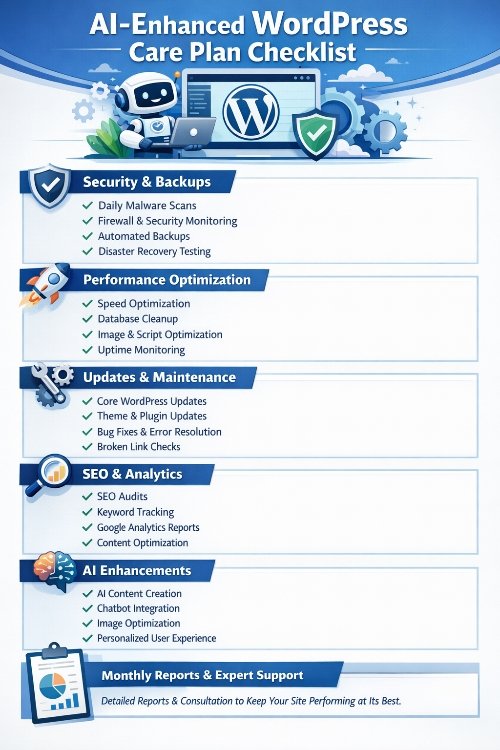
How AI fits into this checklist
AI strengthens the care plan by improving:
- early detection (before the client notices)
- issue prioritisation (what matters most first)
- communication clarity (summary reporting that is client-friendly)
- multi-site management (less manual overhead as you scale)
If your agency provides additional expertise like Generative AI Consulting Services, the care plan becomes even more valuable as part of a broader “smart digital operations” offering—without turning the website into an experiment.
What to Include in an AI-Enhanced WordPress Care Plan (Agency Checklist)
The difference between a “basic maintenance package” and a premium care plan is structure, visibility, and outcomes.
AI-Enhanced WordPress Care Plan Checklist
Include these components to deliver consistent, scalable care:
- Core, theme, and plugin update management (with staging/testing workflow)
- Daily backups (with retention rules and offsite storage)
- Backup restore testing (scheduled verification, not just backup creation)
- Uptime monitoring (with alert thresholds and escalation rules)
- Performance monitoring (Core Web Vitals-focused insights)
- Security hardening basics (firewall rules, login protection, file integrity checks)
- Malware scanning and cleanup process (clear response plan)
- Database optimisation and cleanup (safe revisions control, transient cleanup)
- Broken link monitoring (especially after migrations or content updates)
- SSL and mixed content checks
- Form submission checks (lead forms, booking forms, checkout flows)
- WooCommerce checks (payment gateway, cart, product pages if applicable)
- Plugin conflict detection routines (especially after major updates)
- Monthly reporting (what was done, what was prevented, what’s next)
- Quarterly improvement recommendations (actionable roadmap for upgrades)
- Access control governance (user roles, admin accounts, audit trail)
- Emergency support SLA (response times and defined coverage)
Common Mistakes Agencies Make When Offering Maintenance
A care plan can become a retention engine or a support nightmare. The difference is usually avoidable mistakes.
Selling maintenance as a commodity
If you position care plans as “updates and backups,” clients compare you on price. Instead, position the outcome:
- customer experience reliability
- uptime protection
- brand risk reduction
- performance consistency
No reporting = no perceived value
If the client doesn’t see what’s happening, they assume nothing is happening.
A short monthly report should include:
- next month’s recommendations
- key actions taken
- improvements achieved
- issues prevented (when applicable)
Updates without testing
Blind updates are one of the fastest ways to break websites.
Better approach:
- deploy during lower-risk time windows
- test updates on staging
- validate key pages and conversions
No defined scope or SLA
Clients get frustrated when they don’t know what’s included.
Define:
- emergency pathways
- covered tasks
- response windows
- what counts as “support” vs “new work”
Ignoring performance until it becomes a problem
Many agencies focus on performance only during builds or redesigns. But performance changes over time as:
- images increase
- plugins add scripts
- content grows
- database expands
That’s why ongoing performance monitoring matters.
How to Position Care Plans as a Branding Advantage (Messaging Examples)
To match BrandingX editorial expectations, the messaging should sit in the brand and business value space—not purely technical benefits.
A strong care plan message answers:
- How does it help the agency deliver consistently?
- Why does the brand need this?
- What risk does it reduce?
- What experience does it protect?
Messaging angles that work for agencies
Angle 1: “We protect your digital brand experience.”
Focus on reliability, trust, and consistency.
Angle 2: “Your website should perform like your best salesperson.”
Link maintenance to lead flow, conversions, and availability.
Angle 3: “We prevent issues before they cost you customers.”
Proactive positioning is premium positioning.
Sample messaging examples (use/adapt)
- “We maintain your site like a product, not a one-time project—because modern customers judge brands by friction-free experiences.”
- “Our care plan keeps your WordPress site fast, secure, and reliable—so your brand stays credible when traffic spikes.”
- “A consistent digital experience builds trust. We manage updates, monitoring, and performance so your site supports your growth.”
A strategic note on branding
Even the best branding strategies fail if the website breaks at the moment of truth—during a sale, a press feature, or a first-time visit. That’s why smart agencies treat the care plan as part of the brand system.
If you’re a design-led branding agency working with WordPress, care plans also protect your creative work from being undermined by technical instability.
Mini Case Examples (3 scenarios): Small Business, eCommerce, Corporate
Below are realistic scenarios many agencies see—without relying on inflated claims or fake metrics.
Small Business Scenario: Service Business Lead Generation
A local service business depends on contact forms and mobile traffic. The agency runs seasonal campaigns and local SEO pages.
Common risk:
- forms stop working after plugin updates
- mobile performance drifts down over time
- spam enquiries reduce trust in lead quality
How an AI-enhanced care plan helps:
- form submission monitoring alerts the team early
- performance monitoring identifies slow pages before rankings and conversions slip
- security monitoring helps reduce spam and malicious behaviour
Brand outcome:
The business appears reliable and professional—exactly what prospects need before they enquire.
eCommerce Scenario: WooCommerce Store Growth
An eCommerce brand launches promotions often and relies on stable checkout flows.
Common risk:
- payment gateway issues after updates
- cart errors caused by plugin conflicts
- speed drops during traffic spikes
How AI supports the agency:
- anomaly detection flags conversion drops earlier
- proactive performance monitoring prevents “slow store” perception
- security checks reduce fraud risk and customer distrust
Brand outcome:
Customers complete purchases smoothly, reinforcing confidence and repeat buying.
Corporate Scenario: Multi-Stakeholder Website Governance
A corporate site often has multiple editors, compliance reviews, and strict brand consistency rules.
Common risk:
- content updates break layouts
- outdated plugins cause security vulnerabilities
- inconsistent publishing introduces UX issues
How AI-enhanced care plans help:
- monitoring detects layout shifts and unusual error patterns
- access and security governance reduces risk exposure
- reporting supports stakeholder confidence and accountability
Brand outcome:
The corporate brand stays consistent across regions, devices, and user journeys.
A well-run care plan becomes a foundation for any serious branding company delivering digital experiences at scale.
Conclusion
AI-powered WordPress care plans are no longer just an operational service. For digital agencies, they are a strategic lever that protects performance, reduces risk, and strengthens client trust.
When your sites stay fast, secure, and stable, clients experience your agency as dependable and premium—because reliability is part of modern brand perception. AI improves this outcome by helping agencies spot threats early, monitor performance continuously, and scale consistent standards across multiple client sites without burning out the team.
Ultimately, the agencies that win long-term are the ones that treat WordPress care plans as a brand asset, not an afterthought—because the best creative work deserves a platform that never lets it down.
Want a care plan that keeps your client websites fast, secure, and always aligned with brand performance?
FAQs
What is an AI-powered WordPress care plan?
An AI-powered WordPress care plan combines routine maintenance (updates, backups, security checks) with intelligent monitoring and automated alerts to catch issues early and keep sites stable.
Can AI detect WordPress security threats?
Yes. AI-driven security tools can help identify suspicious login behaviour, unusual traffic patterns, file changes, and other signals that may indicate attacks or vulnerabilities.
How does website speed impact branding?
Speed influences trust and perception. A fast site feels credible and modern, while a slow site feels unreliable—especially on mobile, where first impressions happen quickly.
Are WordPress care plans worth it for agencies?
Yes. Care plans help agencies reduce support chaos, keep client sites performing well, and build recurring revenue through a repeatable operational service.
Do agencies need human support if AI is used?
Absolutely. AI supports monitoring and prioritisation, but human expertise is still required for troubleshooting, decision-making, stakeholder communication, and brand-aligned implementation.
What’s included in a professional WordPress care plan?
Most professional plans include updates, backups, uptime monitoring, security protection, performance optimisation, monthly reporting, and a defined support process for issues and emergencies.
How often should WordPress maintenance be done?
Core tasks should run continuously (monitoring and security). Updates and checks are typically weekly, while reporting and strategic reviews are monthly or quarterly.
Can AI help agencies manage multiple client sites?
Yes. AI makes it easier to monitor many sites at once, detect patterns across them, prioritise urgent issues, and create reporting summaries for clients efficiently.
Will AI-powered care plans improve Core Web Vitals?
They can help significantly by tracking performance trends, highlighting bloat, and flagging issues that affect loading speed and responsiveness, allowing agencies to act before scores drop.
How do agencies explain care plans to clients without sounding technical?
Position the care plan as brand reliability: protecting speed, security, uptime, and customer trust. Clients don’t need the technical details—they need confidence and consistency.
Disclaimer: This article was generated with the support of AI tools and has been thoroughly reviewed, edited, updated, and verified by the author to ensure accuracy, clarity, and relevance. All insights are based on real-world industry trends, current best practices, and practical experience, with final content decisions and quality assurance completed by the author before publication.
Feel free to contact BrandingX for Web Design, Business Branding Services and SEO Services in Ahmedabad.