
AI’s Real Bottleneck in America: Governance, Not Technology
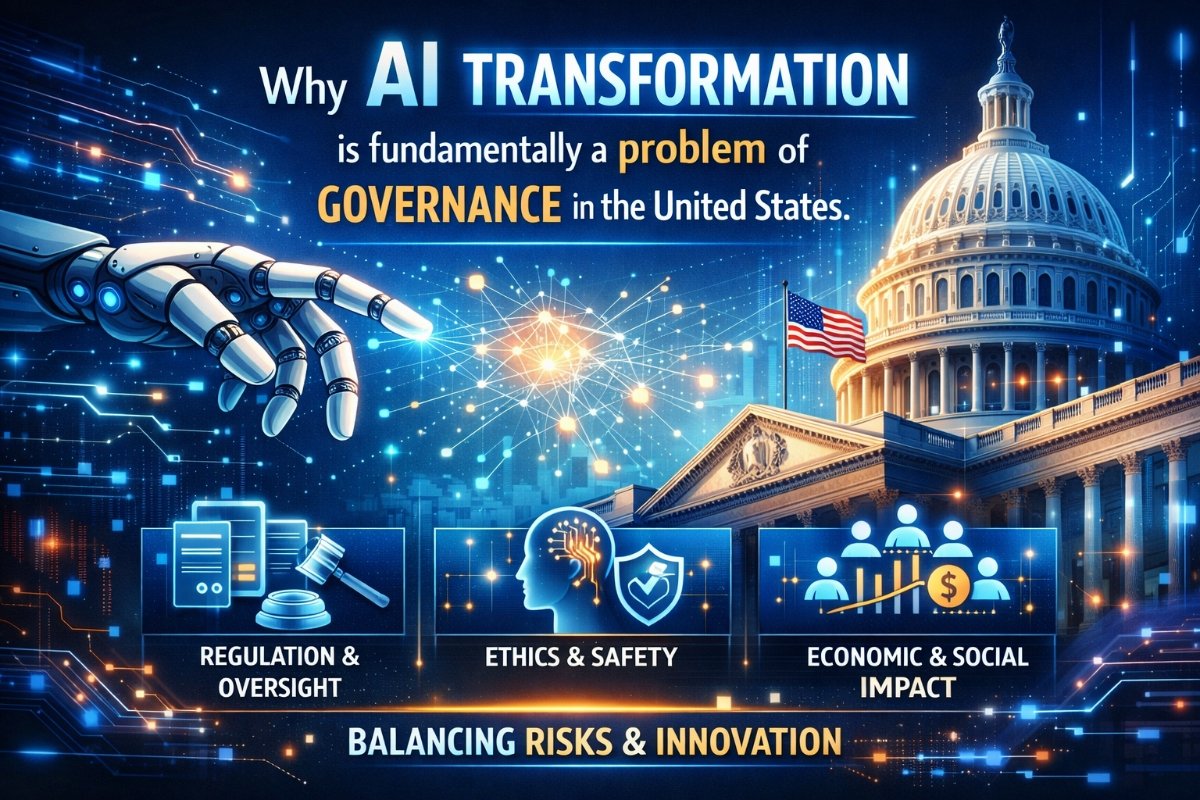
AI is advancing rapidly in the United States, but the real challenge is not building smarter systems. It is governing them effectively across fragmented institutions, uneven regulations, and limited oversight capacity.
Executive Summary
- The U.S. AI challenge is primarily about governance, not technology.
- Federalism creates both flexibility and regulatory fragmentation.
- Agencies are developing frameworks, but enforcement capacity remains limited.
- Recent laws and enforcement actions show uneven progress.
- Without stronger coordination, risks will scale faster than accountability.
Introduction: The U.S. AI Moment
The United States is a global leader in artificial intelligence, driven largely by private-sector innovation. However, as AI systems become widely deployed, the key bottleneck is no longer technical capability but governance.
Governance refers to the institutions, rules, processes, and oversight mechanisms that shape how AI is developed and used. Accountability means assigning responsibility and consequences, while risk management involves identifying and mitigating harms.
In the U.S., these systems are decentralized and complex, creating both strengths and weaknesses.
Why this matters: Without effective governance, rapid AI deployment can outpace society’s ability to manage risks.
What a Governance Problem Means in Practice
AI governance challenges can be grouped into four areas:
- Institutions: Multiple agencies with overlapping roles
- Rules: Mix of laws, guidance, and voluntary standards
- Capacity: Limited technical expertise in government
- Incentives: Market pressure to deploy quickly
Innovation moves in months, while regulation often takes years.
Why this matters: This mismatch leads to reactive governance rather than proactive oversight.
Fragmented Authority and Federalism
The U.S. has no single AI regulator. Instead, authority is distributed across multiple bodies.
- White House Executive Order on AI (Oct 30, 2023)
- OMB guidance for federal agencies (March 28, 2024)
- NIST AI Risk Management Framework (Jan 2023)
- FTC enforcement under consumer protection laws
Example: The 2023 Executive Order relies on existing laws rather than new legislation, limiting its reach.
States are also active, introducing their own AI and privacy laws.
Why this matters: Fragmentation creates inconsistency and complicates compliance.
Patchwork vs. Baseline
The U.S. lacks a comprehensive federal privacy law, leading to a patchwork of state regulations:
- California Consumer Privacy Act (CCPA)
- Colorado Privacy Act
- Illinois Biometric Information Privacy Act (BIPA)
Example: Colorado’s AI Act (May 17, 2024) requires transparency and risk management for high-risk AI systems.
Why this matters: Individuals receive uneven protections depending on location.
Institutional Capacity and Tools
Agencies are building governance tools but face constraints.
- NIST standards for AI risk management
- OMB guidance for federal AI use
- FTC enforcement actions
Example: FTC action against Rite Aid (Dec 19, 2023) over facial recognition misuse.
Challenges include limited technical staff and auditing capacity.
Why this matters: Rules without enforcement capacity have limited impact.
Accountability and Risk
Key questions remain unresolved:
- Who is responsible for AI harms?
- How are risks evaluated before deployment?
- What transparency is required?
Example: The New Hampshire AI robocall incident (Jan 2024) led the FCC to ban AI-generated robocalls in Feb 2024.
Why this matters: Governance is often reactive rather than preventive.
National Security and Coordination
AI governance intersects with national security.
Example: U.S. export controls on advanced chips (Oct 2023, updated 2024).
The U.S. is coordinating internationally, but efforts remain limited.
Why this matters: Weak coordination can undermine global leadership.
Corporate Governance and Self-Regulation
Companies are implementing voluntary safeguards:
- Internal safety teams
- Red teaming
- Public commitments
Example: White House voluntary AI commitments (July 21, 2023).
These measures are non-binding and inconsistent.
Why this matters: Self-regulation cannot replace formal oversight.
Counterarguments
Market self-correction
Markets alone have not effectively addressed systemic risks in past technologies.
Regulation slows innovation
Clear rules can reduce uncertainty and support sustainable innovation.
Global competition requires speed
Poor governance can weaken long-term competitiveness.
Recommendations
- Establish a federal privacy law
- Require risk assessments for high-impact AI
- Increase agency technical capacity
- Develop independent audit systems
- Improve interagency coordination
- Reform public procurement
- Enhance transparency and incident reporting
Conclusion
The United States does not lack AI capability. It faces a governance challenge shaped by fragmentation, limited capacity, and uneven accountability.
The future of AI in the U.S. will depend less on technological breakthroughs and more on how effectively institutions can guide and regulate their use.
Why this matters: Governance will determine whether AI’s benefits are widely shared or unevenly distributed.