
Business Strategy | Branding | Marketing Trends
In an era obsessed with disruption, the world’s savviest brands are turning backward to move forward — and the data proves it’s working.
For most of the past decade, the marketing world had one commandment: disrupt or die. Silicon Valley’s gospel of “move fast and break things” had permeated every boardroom, creative studio, and brand strategy deck from Manhattan to Mumbai. Brands that couldn’t claim they were “changing the game” risked being dismissed as relics. Tradition was a liability. Legacy was baggage. History was something you left behind.
Then something unexpected happened. Consumers — bombarded by a relentless wave of slick launches, influencer noise, and algorithmic hype — began tuning out. Trust in brand newness collapsed. And quietly, almost imperceptibly at first, the brands winning hearts and wallets weren’t the newest ones. They were the oldest.
Heritage branding — the strategic use of a brand’s history, craftsmanship, and cultural legacy as its primary competitive advantage — has staged one of the most remarkable comebacks in modern marketing history. And this time, analysts and creative directors say, it may not be going anywhere.
The Return of the Real: What Heritage Branding Actually Means
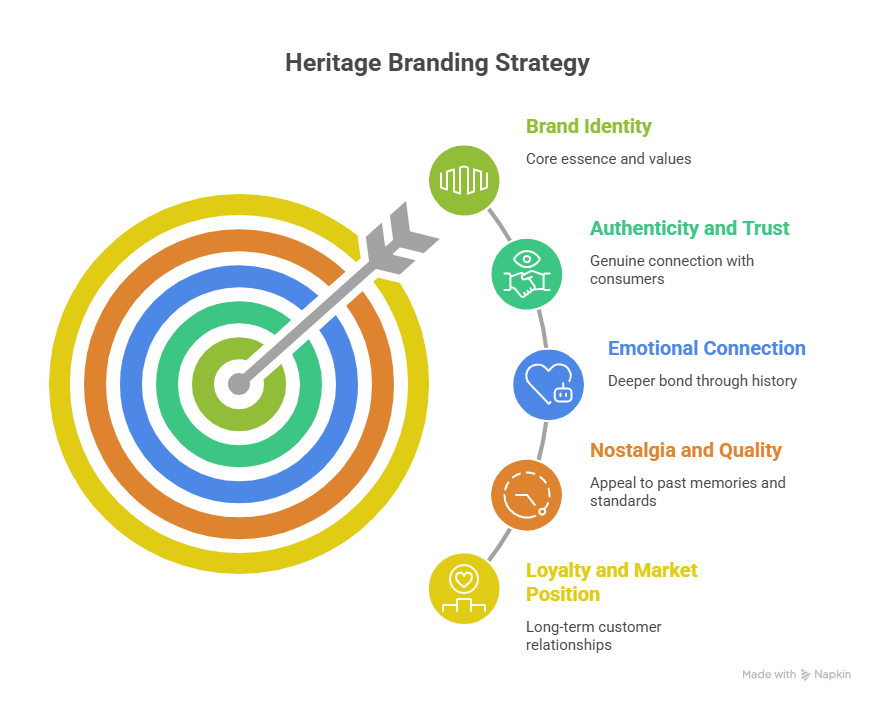
Heritage branding is not nostalgia for its own sake. It is a deliberate, evidence-backed marketing strategy that anchors brand identity in authenticity, longevity, and provenance. At its core, it means mining a brand’s own history — its founding story, its craft traditions, its cultural footprint — and making that history the hero of modern storytelling.
The elements that define heritage branding are both tangible and emotional. Authenticity sits at the center: the genuine ability to say “we have been here, done this, and earned this reputation over decades.” Craftsmanship signals quality through process rather than just product. Cultural storytelling connects the brand to moments in history that consumers already care about. And legacy reputation offers something no advertising budget can manufacture overnight: earned trust.
“Authenticity has become the scarcest commodity in modern marketing,” says a senior brand strategist at a top-five global creative agency. “And the brands that actually have a history suddenly have something that can’t be faked or bought. That’s an extraordinary competitive advantage in a world drowning in manufactured credibility.”
Disruption vs. Legacy: A Tale of Two Brand Philosophies
To understand why heritage branding is surging, it helps to understand what it is replacing — or at least, what it is now competing against.
The disruptive branding era, which dominated roughly from 2010 to 2022, was built on a simple and seductive premise: the old way is broken, and we are the fix. Uber didn’t just offer rides — it declared war on the taxi industry. Airbnb didn’t offer rooms — it challenged the entire concept of hospitality. Tesla didn’t sell cars — it promised to make conventional automakers obsolete. These narratives were thrilling, and for a time, they worked extraordinarily well.
The strategy had genuine business logic behind it. In a digital-first economy where new entrants could scale globally in months, novelty was a legitimate differentiator. Venture capital rewarded bold, category-disrupting narratives. Media amplified them. Consumers, eager for something fresh in the wake of the 2008 financial crisis, responded enthusiastically.
But disruption branding carries inherent structural risks that have become increasingly visible. It requires constant narrative escalation — each claim must top the last. It often sidelines product quality and customer experience in favor of storytelling hype. And critically, it offers no emotional foundation when the novelty wears off. When Uber faced regulatory battles, safety controversies, and driver relations crises, there was no 150-year bedrock of earned trust to absorb the shock. The brand had been built on disruption, not relationship.
Heritage-led storytelling operates from precisely the opposite logic. Rather than promising to destroy the past, it celebrates survival. Rather than claiming to be the future, it proves it has already weathered many futures. That is an increasingly compelling argument in an era when consumers are less impressed by promises and more hungry for proof.
The Proof Is in the Archives: Brands Getting Heritage Right
The brands making heritage branding work in the modern era share a critical understanding: history must be activated, not just mentioned. The archive is not a museum — it is a content engine.
Coca-Cola has perhaps the most sophisticated playbook. The company has spent decades making its 1886 founding, its wartime advertising history, and its iconic bottle design integral to every campaign touchpoint. But in recent years, it has gone further — releasing archival ad campaigns on social media, partnering with streetwear brands using vintage packaging, and reissuing classic recipe cans as premium products. The effect is a brand that feels simultaneously timeless and culturally current.
Levi’s has executed a similarly masterful pivot. After spending much of the 2000s struggling to compete with fast fashion, the brand leaned aggressively into its 1873 origins, its associations with American counterculture, and the durability of its original 501 jeans. Its “Buy Better, Wear Longer” campaign — rooted in the environmental argument that a 150-year-old denim brand knows how to make jeans that last — delivered one of the strongest brand equity gains in the apparel sector in 2023 and 2024.
Burberry spent a decade in the early 2000s watching its heritage become a liability, associated with gang culture and counterfeit goods. Its recovery is a masterclass in heritage rehabilitation — reconnecting with its 1856 trench coat origins, its association with British exploration, and its founder Thomas Burberry’s genuine innovations in weatherproofing. The result: one of the most successful luxury brand turnarounds of the 21st century.
Rolex, meanwhile, has simply never deviated. The Swiss watchmaker has spent a century telling one story: precision, permanence, and achievement. In an age when smartwatches offer more features for a fraction of the price, Rolex’s refusal to compete on technology — and its insistence on competing on heritage — has made it the most recognizable luxury brand on the planet.
Inside the Agency: How Creative Shops Are Rethinking Their Pitch
Across global creative agencies, the shift in client briefs over the past two years has been unmistakable. Where pitch decks once led with disruption strategies, innovation frameworks, and competitive landscape analyses, they now increasingly open with a different question: what is this brand’s story, and how long has it been true?
Brand archive audits — systematic reviews of a company’s historical advertising, founding documents, product catalogs, and cultural moments — have become a formal service offering at several major agencies. The goal is to surface authentic heritage assets that can be activated across modern channels. A 1950s product photograph becomes a limited-edition print campaign. A founder’s letter from 1922 becomes a brand manifesto. A discontinued product line becomes a relaunch event.
Founder narratives have emerged as a particularly powerful heritage tool. In an era of faceless corporate communications, the story of a real person — a craftsman, an innovator, a risk-taker — who built something with genuine conviction, resonates deeply with consumers skeptical of corporate authenticity. Agencies are increasingly building entire campaign architectures around these figures.
Nostalgic brand campaigns, done well, now regularly outperform innovation-led counterparts on key metrics. A 2025 analysis of Super Bowl advertising found that campaigns featuring brand heritage elements achieved 23% higher emotional engagement scores than pure product-innovation campaigns — a striking reversal of the trend just five years prior.
The Psychology Behind the Pull: Why Consumers Crave Heritage Now
Marketing effectiveness ultimately rests on psychology, and the psychology driving heritage branding’s resurgence is well-documented and deep-rooted.
Nostalgia marketing activates neurological reward pathways associated with warmth, safety, and belonging. Research from the Journal of Consumer Psychology consistently shows that nostalgic advertising increases consumer willingness to pay and strengthens brand loyalty — effects that intensify during periods of social uncertainty. In the context of post-pandemic anxiety, geopolitical instability, and the disorienting pace of technological change, heritage brands offer something algorithmically optimized content cannot: genuine emotional anchoring.
Trust built over time operates differently from trust built through clever advertising. When a brand has existed through recessions, wars, technological revolutions, and cultural upheaval, its continued existence is itself a form of proof. Longevity is a signal of reliability that no marketing claim can replicate. Consumers understand this intuitively, even if they can’t always articulate it.
Perhaps most powerfully, heritage branding offers a direct antidote to what researchers now call “authenticity fatigue” — the growing consumer exhaustion with brands that perform authenticity through carefully curated social media personas, influencer partnerships, and purpose-washing campaigns. When a brand’s authenticity is structural rather than performative — built into its founding story, its product craft, and its 100-year record — consumers respond with a qualitatively different kind of loyalty.
The Next Decade: Where Heritage Branding Goes From Here
The convergence of heritage branding with digital storytelling tools will define the next era of the trend. Brands are already beginning to use AI-powered content generation to surface and repackage archival materials at scale — transforming decades of brand history into social-media-ready content with unprecedented efficiency. What once required a six-month archival research project can now be accomplished in weeks.
Immersive heritage experiences are emerging as a frontier. Several luxury and heritage consumer brands are developing augmented reality tools that allow consumers to “walk through” brand timelines, interact with archival products, and witness founding stories in experiential formats that blend digital and physical worlds. The brand museum, long a niche novelty, is being reimagined as a powerful consumer loyalty platform.
The tension between heritage and relevance will also intensify. The risk of heritage branding is well-known: done poorly, it produces brands that feel dated, out of touch, and unable to speak to new generations. The brands that will win the next decade will be those that master what practitioners are calling “dynamic heritage” — the ability to hold authenticity and cultural currency simultaneously, honoring the past without being imprisoned by it.
Younger consumers — particularly Generation Z — present a fascinating opportunity and challenge. Research suggests that Gen Z actually responds powerfully to genuine heritage when it is communicated through contemporary formats. Authenticity, for this generation, is not defined by being new — it is defined by being real. And brands with 50, 100, or 150-year track records have a powerful claim to realness that no startup can match.
The Enduring Advantage of Being Old
The irony of heritage branding’s resurgence is not lost on the marketing professionals who spent the better part of a decade apologizing for their brands’ age. For years, longevity was something to be managed or minimized in a world that celebrated the new. Now it is becoming one of the most defensible competitive moats in business.
The most durable brands of the next decade will likely not be the ones that promised the most radical reinvention. They will be the ones that understood something older and harder to manufacture: that the deepest consumer loyalty is built not on excitement, but on trust — and trust, above all things, takes time.
In that sense, the rise of heritage branding is not a retreat from modernity. It is a redefinition of it. In an age when everything can be generated, manufactured, and faked at scale, what remains genuinely scarce is a real story, honestly told, over a very long time. And for brands fortunate enough to have one, the moment to tell it has never been better.
5 Key Insights
- 71% of global consumers now rank brand heritage above product innovation as a purchase driver (Edelman Brand Trust Barometer, 2025).
- Heritage-led Super Bowl ads achieved 23% higher emotional engagement scores than pure innovation campaigns in 2025.
- Brand archive audits have become a formal agency service, converting historical assets into modern content campaigns.
- Authenticity fatigue is driving consumers away from performative brand purpose and toward brands with genuine, structural history.
- “Dynamic heritage” — honoring the past while remaining culturally relevant — will define the leading brand strategies of the next decade.