
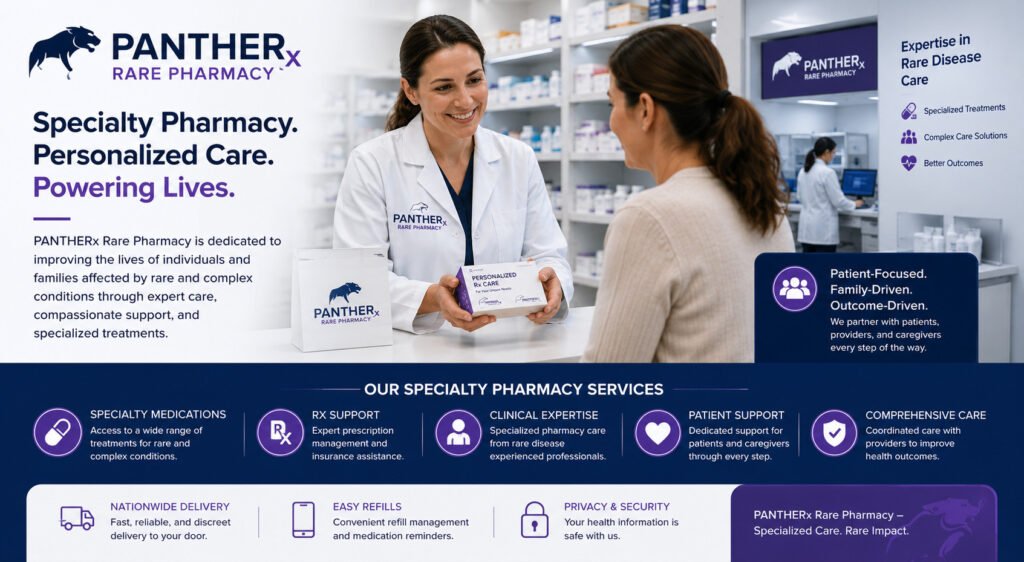
PANTHERx Rare Pharmacy Review: Specialty Pharmacy Services, Rx Support, and Rare Disease Care
A complete review of PANTHERx Rare Pharmacy, the largest independent rare disease specialty pharmacy in the US. Services, Rx support, accreditations, and patient experience explored in depth.
For patients and families living with a rare disease, choosing a pharmacy is rarely a casual decision. The medication may cost more than a car, require precise temperature controlled handling, demand insurance approvals that take weeks to navigate, and need to be administered on a schedule that allows for no real margin of error. The pharmacy on the care team becomes something closer to a long term partner than a transactional vendor, and the quality of that partnership shapes the entire treatment experience.
This review takes a thorough look at PANTHERx Rare Pharmacy, the Pittsburgh based specialty pharmacy that has built its reputation as the largest independent rare disease pharmacy in the United States. We examine what PANTHERx actually offers, how its patient care model works in practice, what its accreditations and awards genuinely mean, and how it compares to other paths a rare disease patient might encounter when seeking access to their prescribed therapy. The goal is to provide a balanced, informative picture that helps patients, caregivers, and prescribers understand whether PANTHERx is likely to be a good fit for their situation.
Who PANTHERx Is and Why the Name Keeps Coming Up
PANTHERx was founded in 2011 in Pittsburgh, Pennsylvania, with a specific and somewhat unusual goal. Rather than competing as another general specialty pharmacy serving high volume conditions like rheumatoid arthritis or multiple sclerosis, the founders decided to build a pharmacy designed exclusively for rare and orphan diseases. At the time, this was an unconventional bet. Rare disease therapies were a small, niche segment of the pharmaceutical market. The founders, however, recognised that the orphan drug pipeline was about to expand dramatically, and that the existing specialty pharmacy infrastructure was not well suited to the unique demands of rare disease care.
That early bet has aged remarkably well. PANTHERx has grown from a small operation, reportedly launched out of a garage, into the largest independent rare disease pharmacy in the country. The company is licensed in all 50 states and US territories, serves patients in partnership with biopharmaceutical manufacturers across dozens of orphan therapies, and has been ranked by Drug Channels Institute among the top specialty pharmacies in the United States by revenue. The PANTHERx pharmacy operation now spans facilities in Pittsburgh and Collierville, Tennessee, providing fully redundant logistics and dispensing capacity.
The reason the PANTHERx name keeps coming up in rare disease conversations is straightforward. When a biopharmaceutical company launches an orphan therapy in the United States, it often needs a pharmacy partner capable of managing the complete patient experience for a very small population spread across the country. PANTHERx specialises in exactly this scenario, and it is frequently selected as the exclusive or limited distribution partner for newly approved orphan medications.
The PANTHERx Specialty Pharmacy Model Explained
To understand what makes PANTHERx specialty pharmacy services different, it helps to understand how traditional specialty pharmacy works first. Most specialty pharmacies are built around operational efficiency. Their economics depend on dispensing large volumes of complex medications across many therapeutic categories, with patient interactions handled through a mix of clinical pharmacists, automated systems, and call centre teams. This model works well for conditions where many patients take similar medications, the disease is well understood by most clinicians, and the supply chain is relatively standardised.
Rare disease pharmacy operates under a different set of constraints. The patient population for any given therapy may be only a few hundred people nationwide. The disease state may be poorly understood outside a handful of specialist physicians. The therapy itself may have just received FDA approval and may have unique handling, dosing, or monitoring requirements that the general pharmacy industry has not yet absorbed. The data reporting needs are different. The supply chain has to be exceptionally reliable because losing a single shipment can have direct clinical consequences.
PANTHERx pharmacy was designed from the ground up for this reality. The company calls its proprietary patient care approach RxARECARE, and the model emphasises long term relationships, therapy specific clinical expertise, and intentional coordination across patients, prescribers, and manufacturer partners. The company’s SWFT technology platform supports this model by giving care teams the tools to track each patient’s journey and to identify potential issues before they become problems.
In practical terms, this means that a patient prescribed an orphan therapy through PANTHERx is not handed off to a generic queue. They are assigned to a team that has worked with the specific therapy and the specific disease state for months or years. The pharmacist counselling them on side effects has actually counselled other patients with the same condition. The care coordinator following up on shipping logistics has shipped that same therapy hundreds of times. The access specialist handling insurance approval has worked through the same payer obstacles before and knows how to overcome them.
What PANTHERx Rare Pharmacy Actually Provides for Patients
The PANTHERx rare pharmacy service offering covers a broader scope of work than most patients expect when they first encounter the company. To make sense of what is actually delivered, it helps to break the experience down into the major components of the patient journey.
The first component is benefits investigation and access support. When a prescription is sent to PANTHERx, the access team begins working immediately to understand the patient’s insurance coverage, identify any prior authorisation requirements, and gather the documentation needed to obtain approval. For rare disease therapies, this process often involves multiple back and forth interactions with the payer, the prescribing physician, and sometimes outside experts whose letters of medical necessity carry weight in appeals. PANTHERx access specialists handle this work on behalf of the patient and prescriber, removing a substantial administrative burden from people who are already dealing with serious health concerns.
The second component is financial assistance navigation. Rare disease therapies frequently carry list prices in the hundreds of thousands of dollars per year, and even patients with strong insurance coverage may face significant out of pocket costs. PANTHERx works to identify and apply available financial assistance for each patient. This may include manufacturer copay assistance programs, charitable copay foundations for patients with government insurance, patient assistance programs for those with no coverage, and other support mechanisms specific to particular therapy areas. The PANTHERx Rx access work has saved many patients substantial sums and made therapy possible for people who would otherwise have been unable to start treatment.
The third component is clinical care and counselling. PANTHERx clinical pharmacists review each prescription for clinical appropriateness, screen for drug interactions, and provide therapy specific counselling to patients and caregivers. For rare disease patients, this counselling is often more in depth than what would happen at a typical retail or specialty pharmacy because the conditions are less familiar and the therapies frequently have specific monitoring requirements that need to be understood clearly before treatment begins.
The fourth component is dispensing and delivery. PANTHERx dispenses medications from its licensed pharmacy facilities and ships directly to patients using validated cold chain solutions where required. The company uses temperature monitored packaging, tracked shipments, and verification protocols to ensure that medications arrive on time and in usable condition. For therapies that require room temperature storage, the logistics are simpler but no less rigorous. The company has built genuine redundancy into its operations by maintaining facilities in both Pennsylvania and Tennessee.
The fifth component is ongoing care coordination. After the initial dispense, PANTHERx remains actively engaged with the patient throughout the course of therapy. Care coordinators follow up on adherence, refill timing, side effect management, and any changes to the patient’s broader healthcare situation. For long term rare disease therapies, this ongoing relationship can extend over many years and becomes one of the most valued aspects of the service.
Accreditations and Industry Recognition
PANTHERx holds an unusually strong set of accreditations and awards, and these credentials are worth examining individually because each one reflects a different dimension of pharmacy quality.
The company was the first national pharmacy to achieve the Distinction in Rare Diseases and Orphan Drugs from the Accreditation Commission for Health Care (ACHC). This was awarded in 2019 with a record setting zero deficiency audit, and it formally recognised PANTHERx as meeting the rigorous standards specifically developed for rare disease pharmacy. PANTHERx also holds the URAC Rare Disease Center of Excellence designation, making it the first pharmacy to hold dual rare disease accreditations from both major accrediting bodies. Additional accreditations from NABP (formerly VIPPS) and other industry bodies round out a credentials list that few competitors can match.
On the patient satisfaction side, PANTHERx has won the MMIT Patient Choice Award nine times, including the 2026 honor announced at Asembia’s AXS26 Summit in April 2026. This award is determined by direct patient feedback through the Specialty Pharmacy Patient Satisfaction Survey, with the highest average Net Promoter Score across independent specialty pharmacies winning each year. The fact that PANTHERx has won this consistently rather than as a one off recognition is a meaningful signal that patients themselves continue to rate the experience positively over time.
Industry recognition has also come from the National Association of Specialty Pharmacy, which named PANTHERx Specialty Pharmacy of the Year, and from rankings by Drug Channels Institute, which has placed PANTHERx among the top specialty pharmacies in the country by revenue and noted its position as the largest independent specialty pharmacy in the US.
The PANTHERx Patient Experience in Practice
Awards and accreditations describe what a pharmacy is supposed to do. The lived experience describes what actually happens when patients engage with the company. Based on patient feedback gathered through the MMIT survey and other public sources, the PANTHERx patient experience tends to be characterised by a few consistent themes.
Patients frequently mention the responsiveness of the care teams. Calls are answered promptly, follow up communication is initiated proactively rather than waiting for patients to chase, and the same care coordinators tend to remain involved over time so patients are not constantly re explaining their situation to new staff. For families dealing with chronic, high stakes therapy, this continuity is genuinely valuable.
The clinical knowledge of the pharmacy team also receives positive feedback. Because the company concentrates expertise around specific therapy areas, the pharmacist a patient speaks with about their rare metabolic disorder, for example, has likely worked with many other patients with the same condition. This depth of knowledge is harder to find at general specialty pharmacies that may only see a handful of patients per rare therapy across a much broader medication catalogue.
Insurance and financial support is another area where PANTHERx tends to receive praise. The combination of dedicated access specialists, established relationships with copay assistance programs, and persistence through prior authorisation processes makes a real difference for patients who might otherwise face long delays or unaffordable out of pocket costs.
It is worth acknowledging that no pharmacy delivers a perfect experience for every patient every time. Some patients have reported frustrations with specific incidents, particularly during periods when manufacturer launches drove unusually high volumes or when individual cases ran into complex insurance situations that required extensive resolution time. The 2026 PANTHERx commissioned research conducted with Morning Consult, surveying patients and caregivers across a dozen specialty pharmacies, found that 90 percent of rare disease patients and caregivers report some delays due to communication issues across the broader specialty pharmacy industry. This is an industry wide challenge rather than a PANTHERx specific issue, but it provides useful context. PANTHERx has used these findings to publicly advocate for better care coordination across the rare disease ecosystem and to refine its own model.
How PANTHERx Compares to Other Specialty Pharmacy Options
For patients and prescribers evaluating their pharmacy options, it helps to understand how PANTHERx fits within the broader specialty pharmacy landscape in the United States.
The largest specialty pharmacies by revenue are typically affiliated with pharmacy benefit managers (PBMs), including Accredo (affiliated with Cigna and Express Scripts), CVS Specialty (affiliated with CVS Caremark), and OptumRx Specialty (affiliated with UnitedHealth Group). These PBM affiliated specialty pharmacies dominate dispensing volume because PBM contracts often steer patients toward the affiliated pharmacy for specialty drug coverage. They serve broad therapeutic categories and operate at enormous scale.
PANTHERx is structurally different. It is the largest independent specialty pharmacy in the US, meaning it is not affiliated with a PBM. This independence gives it strategic flexibility to focus exclusively on rare and orphan diseases rather than spreading attention across all specialty conditions. For rare therapies that require limited distribution or exclusive partnerships, manufacturers often prefer this kind of focused, independent partner because it provides clearer accountability, more consistent patient experience, and deeper therapy specific expertise than a generalist pharmacy can typically offer.
For patients, the practical implication is that PANTHERx is often the only pharmacy through which a particular therapy can be obtained, because the manufacturer has chosen exclusive distribution. In other cases, PANTHERx is one of a small number of options. Rarely is PANTHERx competing for the same prescription against a dozen other pharmacies, because its therapy areas are intentionally narrow.
What PANTHERx Does Particularly Well
Drawing on the available evidence, several areas stand out as genuine strengths.
The first is therapy specific expertise. By concentrating on a defined set of rare disease therapies and dedicating specific teams to each one, PANTHERx develops the kind of granular knowledge that is essentially impossible to find at generalist specialty pharmacies. For a patient with a condition affecting only a few hundred people in the country, this expertise is invaluable.
The second is access support. The combination of insurance navigation, prior authorisation handling, and financial assistance work consistently emerges as one of the most valued aspects of the PANTHERx service. Patients often describe being able to start therapy faster and with less financial stress than they had feared.
The third is logistics reliability. Rare disease therapies cannot afford disrupted supply, and the PANTHERx investment in dual facilities, validated shipping solutions, and redundant operations gives genuine confidence that medications will arrive when needed.
The fourth is patient continuity. The relationship based model means patients are not constantly working with new contacts who do not know their history. This continuity reduces the cognitive load on patients and caregivers who are already managing complex situations.
The fifth is industry leadership. PANTHERx has been a vocal advocate for rare disease patients beyond its own client base, sponsoring research, contributing to industry standards, and engaging with patient advocacy organisations. This broader engagement reflects a level of commitment to the rare disease community that goes beyond commercial self interest.
Where PANTHERx Has Room to Improve
A balanced review needs to acknowledge areas where the experience is not always ideal.
First, scale brings challenges. As PANTHERx has grown rapidly, particularly with multiple new therapy launches in recent years, some patients have reported occasional periods where response times slowed or specific issues took longer to resolve. The company has continued to invest in capacity and technology to address these growing pains, but the trade off between rapid growth and consistent service quality is real for any expanding organisation.
Second, rare disease care is genuinely complex, and not every issue can be resolved as quickly as patients might wish even with the best pharmacy in the world. Insurance denials, manufacturer supply constraints, and clinical complications all introduce variability that no pharmacy fully controls. PANTHERx tends to handle these situations well, but patients should set realistic expectations about how long some processes can take.
Third, employee feedback on platforms like Glassdoor and Indeed is mixed. The company holds a 4.0 out of 5 rating on Glassdoor based on dozens of reviews, which is in line with the broader healthcare industry, but individual employee reviews highlight both strengths (patient mission, meaningful work) and frustrations (rapid growth pains, management variability). This is relevant for patients only insofar as employee morale eventually shapes service quality, and the picture is broadly positive but not unanimous.
How to Engage with PANTHERx as a Patient or Prescriber
For patients prescribed a therapy that PANTHERx distributes, the engagement process typically begins when the prescriber sends the prescription directly to PANTHERx. The pharmacy then reaches out to the patient to begin the benefits investigation, financial assistance review, and clinical onboarding process. Patients are not usually expected to contact PANTHERx first, although the company maintains contact information on its website and a toll free phone line for inquiries.
For prescribers who believe their patient may benefit from a PANTHERx distributed therapy, the company provides resources for healthcare professionals including therapy specific information, enrollment forms, and direct lines to clinical and operational teams. The prescriber experience tends to be smoother when offices are familiar with the rare disease pharmacy workflow, which differs in some respects from the general specialty pharmacy experience.
For caregivers, the PANTHERx model is particularly relevant because rare disease care often involves significant caregiver involvement. The company explicitly designs its communication and education around the reality that family members and caregivers may be the primary point of contact for patients who are children, who have cognitive or communication challenges, or who are simply too overwhelmed by their condition to manage all aspects of therapy themselves.
Insurance, Cost, and Access Considerations
One of the most common questions about any specialty pharmacy is what it costs and whether insurance covers it. The answer for PANTHERx, as for any specialty pharmacy, depends entirely on the specific therapy, the patient’s insurance coverage, and the manufacturer’s pricing and assistance programs.
The therapies PANTHERx dispenses typically have list prices that are far beyond what any patient could pay out of pocket. However, the actual cost to most patients is dramatically lower because of insurance coverage and manufacturer assistance programs. PANTHERx access specialists work to identify the most favourable coverage path and to apply available assistance before the patient ever sees a bill. For many patients, the effective out of pocket cost ends up being modest or zero, even for therapies with very high list prices.
For patients with commercial insurance, manufacturer copay assistance programs are usually available and can reduce out of pocket costs significantly. For patients with Medicare, Medicaid, or other government insurance, federal regulations prohibit manufacturer copay assistance, but charitable copay foundations may be able to help. The PANTHERx access team is experienced at identifying and applying for these programs.
It is worth understanding that the pharmacy itself does not set the price of the medication. PANTHERx dispenses therapies at prices set by manufacturers and reimbursed by payers. The value PANTHERx adds is in the access, coordination, and clinical support around the medication rather than in the medication price itself.
The Broader Significance of the PANTHERx Model
Beyond the practical question of whether PANTHERx is a good pharmacy for any individual patient, the company’s approach has broader implications for how rare disease care is delivered in the United States.
By demonstrating that a focused rare pharmacy model could work commercially while delivering measurably better patient outcomes, PANTHERx helped establish rare pharmacy as a recognised sub specialty within the broader specialty pharmacy industry. The ACHC Distinction in Rare Diseases and Orphan Drugs that PANTHERx earned first now provides a path for other pharmacies to develop similar capabilities. The MMIT Patient Choice Award benchmarks have set expectations for what patient satisfaction in rare disease pharmacy looks like. The research PANTHERx has commissioned and published on rare disease care coordination has contributed to industry wide conversations about how to reduce fragmentation and improve patient experience.
The company has also demonstrated the commercial viability of independent specialty pharmacy in an era when PBM affiliated pharmacies dominate dispensing volume across most therapeutic categories. By focusing on rare disease, where exclusive and limited distribution arrangements protect against PBM driven channel pressure, PANTHERx has built a sustainable business that serves patients without being part of a vertically integrated payer organisation. This independence is itself a meaningful structural feature of the company.
Final Verdict on PANTHERx Rare Pharmacy
For patients with rare diseases prescribed therapies that PANTHERx distributes, the company offers what is, by most reasonable measures, the leading dedicated rare pharmacy service available in the United States. The combination of focused therapy expertise, robust access support, reliable logistics, continuity of care, and industry leading patient satisfaction scores makes PANTHERx a strong choice when the option is available.
The PANTHERx pharmacy experience is not flawless. Rapid growth, rare disease complexity, and the inherent challenges of insurance based healthcare in the US mean that some patients will encounter friction at various points. However, the overall quality of the service consistently outperforms the broader specialty pharmacy industry in patient satisfaction surveys, and the structural features of the company, including its accreditations, its independence, and its therapy specific organisation, are genuinely differentiated.
For prescribers serving rare disease patients, working with PANTHERx tends to be a positive experience because the operational and clinical sophistication of the company supports rather than burdens the prescribing process. For manufacturers selecting a specialty pharmacy partner for an orphan therapy, PANTHERx has established itself as a frequent first choice for good reason.
For anyone researching specialty pharmacies generally and wondering whether PANTHERx lives up to its reputation, the available evidence suggests that it largely does. The company has earned its position as the largest independent rare pharmacy through sustained execution rather than marketing, and the patient feedback that drives awards like the MMIT Patient Choice Award provides ongoing third party validation of that execution.
Related Topics That Build a Complete Understanding of PANTHERx and Rare Disease Pharmacy
The PANTHERx story connects to a wider set of topics that anyone seeking to understand specialty pharmacy and rare disease care benefits from exploring in depth. These adjacent subjects each deserve their own dedicated examination, and together they form the broader context within which PANTHERx operates.
Specialty pharmacy versus retail pharmacy is a foundational distinction worth understanding clearly. The differences in handling complex medications, the role of dedicated clinical pharmacists, the use of specialised distribution channels, and the patient interaction models all set specialty pharmacy apart from the corner drugstore. Understanding this distinction is essential context for evaluating PANTHERx specifically and rare pharmacy generally.
The Orphan Drug Act and the regulatory framework for rare diseases shapes everything about how PANTHERx operates. The 1983 legislation, its amendments over the decades, the FDA orphan designation process, and the commercial incentives created by market exclusivity for orphan therapies all provide essential background for understanding why rare pharmacy exists as a distinct business.
Pharmacy benefit managers and their relationship with specialty pharmacies is a complex subject that affects how patients access rare disease therapies. Understanding PBM contracting, formulary management, prior authorisation processes, and the role of PBM affiliated pharmacies helps explain why independent specialty pharmacies like PANTHERx have carved out their particular niche.
Limited and exclusive distribution networks are a defining feature of rare disease therapy access. The strategic logic behind manufacturers selecting one or a small number of specialty pharmacies for a given therapy, the operational requirements that participating pharmacies must meet, and the patient implications of these arrangements are all worth exploring in depth.
Patient assistance programs, copay foundations, and financial support for high cost therapies represent a major part of how rare disease patients afford their medications. The landscape of available programs, the eligibility rules, the differences between commercial and government insured patients, and the work pharmacies do to navigate these resources all matter directly to anyone facing rare disease therapy costs.
Cold chain logistics for biological and temperature sensitive medications is a technical area that nonetheless directly affects patient outcomes. The validated shipping solutions, monitoring technology, packaging engineering, and quality systems that support reliable cold chain delivery are essential capabilities for any rare disease pharmacy.
FDA orphan drug approvals and the rare disease pipeline continue to expand at an accelerating pace. The recent and forthcoming therapy launches in areas like gene therapy, RNA based medicines, and precision oncology are reshaping what rare pharmacy needs to support, and tracking this pipeline provides useful context for understanding where PANTHERx and the broader rare pharmacy industry are headed.
Rare disease patient advocacy organisations play important roles in supporting patients, advancing research, influencing policy, and connecting the rare disease community. Groups like the National Organization for Rare Disorders, EveryLife Foundation, and disease specific patient advocacy groups all interact with the rare pharmacy ecosystem in meaningful ways.
Centers of Excellence for rare diseases, where many rare disease patients receive specialist care, form the clinical anchor of the rare disease care system. The relationships between these specialist clinical centres, the rare pharmacies that distribute therapies, and the patients who travel to access expert care all contribute to how rare disease care actually functions in practice.
Net Promoter Score and patient satisfaction measurement in healthcare provides the methodological foundation for awards like the MMIT Patient Choice Award that PANTHERx has won repeatedly. Understanding how these surveys work, what they measure, and what their limitations are helps put accolades into appropriate context.
The future of rare disease pharmacy is itself an evolving topic. New therapy modalities, increased pricing scrutiny, expanding patient populations as more rare diseases get treatments, and ongoing technology developments all continue to reshape the field. PANTHERx itself continues to evolve, with leadership transitions, facility expansions, and new manufacturer partnerships announced regularly.
Comparing PANTHERx with other specialty pharmacies, including PBM affiliated pharmacies like Accredo, CVS Specialty, and OptumRx Specialty, as well as other independent specialty pharmacies, helps clarify what makes PANTHERx distinctive and what alternatives exist for patients in different situations.
Closing Thoughts on the PANTHERx Review
PANTHERx Rare Pharmacy occupies a distinctive position in the United States healthcare system. It is large enough to invest in the infrastructure, technology, and clinical depth that rare disease therapies require, but focused enough to maintain the therapy specific expertise and patient continuity that generalist pharmacies cannot replicate. The company has earned its credentials through sustained delivery rather than marketing claims, and its repeated patient satisfaction recognitions provide ongoing third party validation of the experience it delivers.
For rare disease patients, prescribers, and families, the practical takeaway from this review is that PANTHERx is generally a strong specialty pharmacy partner for the therapies it distributes. The company is not a universal solution for every medication, because its focus is intentionally narrow, but within the rare and orphan disease space it has built a service offering that consistently performs well across the dimensions that matter most to patients. Whether you are encountering PANTHERx for the first time as a newly diagnosed patient, considering a referral as a prescriber, or simply researching rare disease pharmacy as part of broader healthcare interest, the company is worth understanding in depth as one of the most important players in this corner of American healthcare.